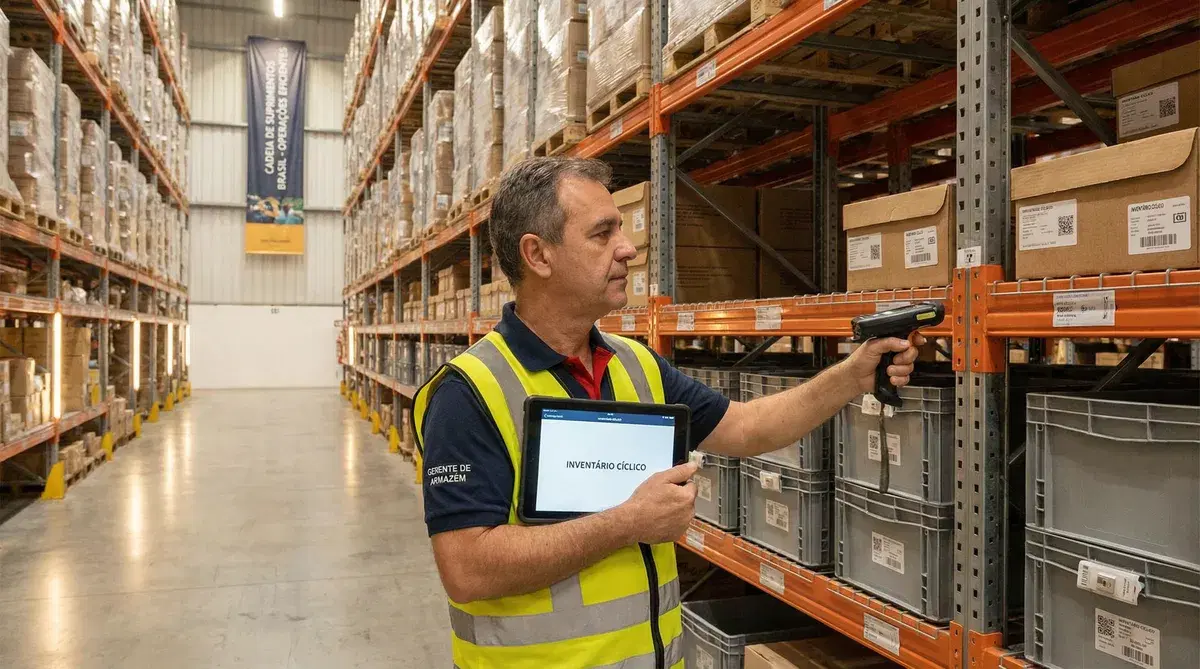
Cycle counting: accuracy as a routine, not an annual event
Rolling perpetual inventory counts with ABC frequencies, disciplined variance investigation and records your auditor can rely on — designed and delivered by CPCON.
The annual stocktake has a structural flaw: it measures accuracy on one day and corrects it on one day, which means for the other 364 the business trades on numbers it knows are drifting. By the time the count lands, the causes of the variances — a receiving error in March, a unit-of-measure fault in June — are unrecoverable. The adjustment gets posted; the process that produced it survives untouched, and next year produces the same write-off.
Cycle counting inverts that model. A defined slice of the stock file is counted every day or week on a rolling schedule, so each SKU is counted at a frequency proportionate to its value, velocity and risk. Errors are caught within days, while the transaction trail still explains them; root causes get fixed, not just corrected. Accuracy stops being an event and becomes a property of the operation.
What a CPCON programme includes
ABC stratification & schedule design
Count frequencies set by value, velocity and shrinkage history — every SKU covered over the cycle, the risky ones covered often.
Rolling counts, blind by default
Counters see locations, not expected quantities — removing confirmation bias. Recount rules trigger automatically on variance thresholds.
Root-cause investigation
Every material variance classified — receiving, picking, master data, cut-off, loss — and trended, so fixes target processes rather than symptoms.
KPIs and audit-grade records
Record accuracy and location accuracy tracked separately, with documented procedures and results your auditor can test.
What perpetual inventory actually means
Perpetual inventory is the principle that the book balance is kept live and continuously verified, rather than reset once a year. The system records every receipt, issue and movement as it happens, and cycle counting is the verification layer that keeps those running balances honest. Without counting, a perpetual system slowly decouples from reality: every mis-pick, mis-scan and unrecorded breakage widens the gap until the annual count reveals — too late — how far it has drifted.
Cycle counting is what closes that loop. By counting a rotating slice every day and correcting the small errors immediately, the perpetual balance stays close to physical reality at all times. The business can then trust its own numbers for replenishment, allocation and reporting on any given day — not only in the week after the annual count. That trust is the entire commercial point: a stock figure you cannot rely on is a stock figure you have to re-verify before every important decision.
ABC analysis: counting effort where it pays
Counting every SKU equally is a waste of effort, because not every SKU matters equally. ABC analysis applies the Pareto principle to the stock file: a small fraction of lines carries most of the value and most of the risk, and that fraction deserves most of the counting attention. Classifying the catalogue into A, B and C bands lets a programme deliver the great majority of the accuracy benefit for a fraction of the effort of a flat, count-everything regime.
| Class | Profile | Count frequency | Typical examples |
|---|---|---|---|
| A — critical | Small share of SKUs, large majority of value or risk | Counted most often (e.g. monthly or more) | High-value lines, fast movers, theft-prone or line-stopping items |
| B — important | The middle band of value and movement | Counted at a moderate interval (e.g. quarterly) | Steady movers of moderate value |
| C — routine | The long tail of low-value, low-risk lines | Counted least often, but at least once per cycle | Slow movers, low-cost consumables, bulky low-value stock |
Pure value, though, is too blunt on its own. A low-cost component that stops a production line if it is missing matters far more than its unit price suggests; a high-theft category needs frequent counting even at modest value; a fast mover accumulates transaction error quickly and so drifts faster. We therefore layer movement velocity, shrinkage history and operational criticality on top of the value ranking, producing a classification that reflects real risk rather than just cost. And because the catalogue changes — new lines, seasonal swings, discontinued SKUs — we rebalance the classification quarterly. A static ABC plan decays.
Setting count frequencies
Once items are classified, the schedule assigns each class a count frequency, with the iron rule that every SKU is counted at least once per cycle. A common starting framework counts A-class frequently, B-class at a moderate interval and C-class a handful of times a year — but the starting numbers are exactly that, a starting point. The right frequency is the one your accuracy results validate: if A-class accuracy is consistently clean, the frequency may be eased; if a class keeps throwing variances, it is counted more often until the underlying cause is fixed. The schedule is designed to spread the workload evenly across the days and weeks so it is absorbed into normal operations rather than arriving as a peak.
Cycle counting versus the annual stocktake
Both have a place — a full count is still the cleanest way to establish an absolute baseline — but as the ongoing control they are not equivalent. The annual count is a snapshot; cycle counting is a continuous signal. The comparison below is the case we make to most operations that are still relying on a once-a-year wall-to-wall count as their only control.
| Dimension | Annual stocktake | Cycle counting programme |
|---|---|---|
| Accuracy | Correct once a year; drifts for the other 364 days | Held continuously high; errors caught within days |
| Root causes | Trail is cold by year-end; cause unrecoverable | Caught while transactions still explain them; fixed at source |
| Disruption | Warehouse shutdown or overnight scramble | A small slice each day; no shutdown |
| Audit position | Auditor attends a single material count | Auditor may rely on the programme and its results |
| Stockouts & service | Phantom stock causes missed replenishment all year | Book balance trusted; replenishment fires correctly |
| Effort profile | One large peak of cost and overtime | Steady, plannable, absorbed into operations |
The benefits, concretely
A well-run cycle counting programme pays back in several distinct ways, and it is worth separating them because they land on different parts of the business:
- Continuous accuracy. The book balance is trusted on any day, not just after the annual count — so replenishment, allocation and reporting run on real numbers.
- Fewer stockouts and less phantom stock. Catching errors early stops the system both holding stock that is not there and missing stock that is, which is what causes lost sales and emergency buys.
- Root causes fixed, not repeated. Because variances are investigated while the trail is warm, the receiving error or master-data fault behind them gets eliminated rather than re-written-off next year.
- No annual shutdown. Counting a small slice daily removes the warehouse-closure or all-night-scramble cost of the wall-to-wall count.
- A better audit position. A documented programme with clean results gives your auditor something to rely on, potentially reducing year-end count effort.
- Earlier shrinkage signal. Loss shows up in weeks, not at year-end, so a shrinkage investigation starts while the evidence still exists.
The audit angle
Cycle counting is not only an operational tool — done properly, it changes the audit conversation. Where stock is material, ISA (UK) 501 expects the auditor to attend physical counting; for entities running a perpetual inventory system, auditors can instead test the controls around the cycle counting programme and the accuracy results it produces. A programme with documented procedures, blind counts, full coverage and investigated variances gives them something worth relying on — and gives you a year-end without a warehouse shutdown. The underlying record-keeping duty, Companies Act 2006 s.386, is satisfied continuously rather than annually.
One boundary should be stated plainly. Whether the auditor places reliance on the programme is the auditor’s judgement, not ours, and CPCON issues no audit opinion of its own. Any certification or sign-off is produced by your auditor; we run the programme to a standard that makes reliance defensible and hand over the documented procedures, count records and accuracy history they need to form that judgement. For the fully third-party version used at year-end and for lenders, see our independent stock audit service.
How we implement it
- Baseline count. A wall-to-wall stocktake establishes a clean starting position — cycle counting maintains accuracy; it cannot create it from a corrupt base.
- Programme design. Stratification, frequencies, blind-count rules, variance thresholds, adjustment authorisation levels and the reconciliation workflow — documented so the programme survives staff turnover.
- Delivery. Managed counts by CPCON teams, a trained-and-assured client team, or hybrid — with independent test counts either way.
- Review and rebalance. Quarterly accuracy trending, schedule rebalancing as the catalogue moves, and escalation of persistent loss patterns into shrinkage investigation.
KPIs: measuring whether it is working
A cycle counting programme is only worth running if it can be measured, and the measurement has to distinguish improvement from mere repair. We track a small, honest set of KPIs and trend them over time, by count, by ABC class and by location:
- Inventory record accuracy (IRA). The share of counted SKUs or locations matching the system within tolerance — the headline measure of whether the records can be trusted.
- Location accuracy. Whether stock is physically where the system says it is, tracked separately because it fails for different reasons than quantity accuracy.
- Net variance value. The monetary size of the adjustments arising, valued at cost, so finance can see the P&L exposure trend.
- Count coverage and adherence. Whether the planned counts are actually happening on schedule — a programme that quietly falls behind stops working.
- Variance cause mix. The breakdown of what is driving error (receiving, picking, master data, cut-off, loss), so improvement effort is aimed at the dominant cause.
The decisive signal is the second derivative: not just high accuracy, but accuracy that improves because fewer errors are being created in the first place. A programme that holds a steady accuracy number by tirelessly correcting the same recurring faults is working hard but not improving the operation. A programme where the variance count falls because the receiving process was fixed is the one that pays back permanently.
Technology that multiplies the effect
Faster counts make higher frequencies affordable, and that is where scanning technology earns its place. Barcode scanning removes the transcription error and slowness of manual count sheets; RFID goes further, reading many tags per second without line of sight so a location, an aisle or a whole store can be cycle counted by reader sweep in minutes. That speed is what lets high-velocity operations count their A-class lines weekly or even daily without a dedicated counting army — turning “continuous accuracy” from an aspiration into routine.
Technology multiplies the effect: RFID-tagged stock can be cycle counted by reader sweep in minutes, which is how high-velocity operations achieve near-continuous accuracy. For distribution-specific count design, see our logistics & warehousing page; retailers will find the store-side version under retail. The full reconciliation discipline behind every count is described on our stock reconciliation page.
Integrating counts with your WMS or ERP
The schedule decides which class is due; the system the warehouse already runs on decides exactly when a count is cheapest and most useful to take. A cycle counting programme is at its strongest when its triggers are wired into the warehouse management or ERP system rather than driven off a standalone spreadsheet, because the system already knows the moments at which a location is empty, a balance has gone negative, a replenishment has fired or a high-value line has just been touched. Counting at those moments captures accuracy at the point where verification is nearly free and error is most likely — and it keeps the programme honest, because the count tasks come from the same data the operation is trading on.
In practice that means a handful of system-driven triggers folded into the daily slice. A zero-balance check asks a picker to confirm an empty bin the moment the system says it is empty — a free count at the cheapest possible point. A negative-on-hand alert forces an immediate count whenever a balance goes below zero, because a negative is proof of an error that has already happened. A replenishment trigger counts a pick face as it is topped up, when the stock is being handled anyway. A threshold trigger raises a count when an item drops to its reorder point, so the number the buyer is about to act on is verified first. We design the programme so these opportunity counts are merged with the value-weighted ABC schedule rather than fighting it, and so the adjustments they produce flow back through the same governed reconciliation workflow — cause-coded, authorised and trended — as every other count, instead of being quietly corrected inside the WMS where no one learns anything from them.
What makes a count wrong — and how cycle counting finds it
A variance is only the symptom; the value of cycle counting is that it catches the symptom while the cause is still recoverable. The same difference between book and physical can come from half a dozen very different failures, and they need very different fixes — which is why every material variance is classified rather than simply adjusted away. The table below sets out the common causes of inventory inaccuracy and how a disciplined cycle counting programme distinguishes them from one another.
| Cause of inaccuracy | How it corrupts the record | How cycle counting detects it |
|---|---|---|
| Receiving errors | A delivery is booked in at the ordered quantity rather than the quantity actually received, or against the wrong line — so the book balance is wrong from the moment stock arrives. | A-class and opportunity counts at putaway catch the discrepancy within days, while the goods-in paperwork and delivery note still exist to prove the cause. |
| Mis-picks & mis-issues | The wrong item or the wrong quantity leaves the location, so two balances are now wrong at once — the line that was over-picked and the line picked in its place. | Frequent counts on fast-moving A-class lines surface the paired error quickly; trending the variance mix shows whether picking is the dominant cause. |
| Putaway in the wrong location | Stock is physically present but in a different bay from the one the system records, so a count of the system location reads short and the real location reads over. | Location accuracy is tracked separately from quantity accuracy, so a misplacement is identified as a location error rather than wrongly written off as loss. |
| Unit-of-measure & conversion faults | An each is booked as a case, or a pack quantity is mis-defined in the master data, multiplying or dividing the true figure by the pack size. | A recurring, proportional variance on the same SKUs points straight at a master-data fault rather than a counting mistake, and the fix is structural. |
| Cut-off errors | A receipt or despatch is recorded in the wrong period — counted as in stock when it has shipped, or excluded when it has arrived — distorting the balance around the count. | Documented cut-off discipline on every count isolates timing differences from real variances, so a movement in transit is reconciled rather than mistaken for loss. |
| Shrinkage & loss | Theft, damage, spoilage or unrecorded sampling removes stock with no corresponding transaction, leaving the system showing inventory that no longer exists. | Once receiving, picking, location and master-data causes are excluded, the residual unexplained variance is the genuine loss signal — and it surfaces in weeks, not at year-end. |
Reading the causes this way is what turns a count into a diagnosis. An annual stocktake can tell you the records were 4% out; it cannot tell you that most of the gap was a unit-of-measure fault on three SKUs and a recurring receiving error from one supplier, because by year-end the trail that would prove it is long gone. A cycle counting programme that codes every variance builds exactly that picture month by month — and aims the improvement effort at the dominant cause rather than spreading it thinly across symptoms.
A short worked example
The shape of the payback is easiest to see in a narrated case. A regional distributor came to a cycle counting programme after a year-end count landed a six-figure write-off that nobody could explain. Their only control had been the annual wall-to-wall count; between counts the book balance was trusted by default, and service had been slipping — pickers were increasingly finding locations short, and buyers had started padding orders to compensate for a stock figure they no longer believed.
We began with a clean baseline count to reset the book balance, then stratified the file by ABC and stood up a rolling schedule: the highest-value and fastest-moving lines counted frequently, the long tail reached at least once per cycle, and zero-balance and negative-on-hand triggers wired into the WMS so the system raised its own counts. Crucially, every variance was counted blind and cause-coded rather than simply posted. Within the first few weeks the diagnostic picture emerged: a large share of the error traced to two recurring sources — a goods-in team booking certain pallet deliveries at ordered rather than received quantity, and a mis-defined case pack on a cluster of fast movers that multiplied the book figure every time those lines were received.
Neither cause was visible from the year-end number; both were fixable once named. The receiving step was tightened and the master data corrected, and the accuracy trend confirmed the fix had held — the variance count on those lines fell rather than merely being re-corrected each cycle. The commercial effect followed the data: with the book balance trusted again, buyers stopped padding orders, the safety stock built to compensate for bad records was trimmed, and the following year-end produced a series of small, explained adjustments instead of a single unexplained shock. The programme had stopped repairing errors and started preventing them — which is the entire point.
The business case: what accuracy is worth
Cycle counting is an investment of counting effort, and it earns its return by removing costs that an annual-count regime simply absorbs as unavoidable. Those costs are larger and more pervasive than they look, because inaccurate stock records do not fail loudly — they bleed quietly across the operation every day.
Inaccurate records cause phantom stockouts, where the system shows availability that is not there and a sale is lost or a customer disappointed; they cause over-ordering, where buyers cover for stock they cannot trust and tie up working capital in safety stock that exists only to compensate for bad data; they cause expedited freight and emergency purchasing when the gap is discovered too late; and they cause a year-end write-off that lands as a single shock because twelve months of small errors were never corrected. A cycle counting programme attacks every one of those: replenishment fires on numbers that are right, safety stock can be trimmed because the records are trusted, errors surface in days rather than at year-end, and the annual shock flattens into a series of small, explained adjustments.
There is also a soft return that compounds the hard one. When the records can be trusted, the whole organisation stops re-verifying them before every decision — the buyer who used to walk the warehouse to check, the planner who kept a private spreadsheet, the manager who discounted the system number by instinct. Restoring confidence in the stock figure is itself a productivity gain, and it is the reason operations that adopt cycle counting rarely go back.
Setting and holding accuracy targets
A programme needs a target to aim at, and the target should be set by class rather than as a single blanket figure. A-class lines — the value and the risk — warrant a demanding accuracy standard, because those are the records whose errors hurt most; the long tail of C-class items can hold a looser tolerance without material harm. We agree the targets up front, in the count tolerances and the recount rules, so “accurate” means something specific and testable rather than a vague aspiration.
Holding the target is then a matter of the feedback loop. When a class slips below its target, the response is not simply to count it more — it is to find and fix the cause that is generating the error, then confirm the fix held by watching the accuracy recover. That is the discipline that turns a target from a stick into a diagnostic, and it is what separates a programme that genuinely improves the operation from one that merely works hard to stand still.
Methods of selecting what to count
ABC frequency decides how often each class is counted; it does not by itself decide which specific items get counted on a given day. There are several established methods for selecting the daily slice, and a mature programme blends them rather than relying on one.
Control-group counting
A small set of items is counted repeatedly over a short period. The purpose is not the stock itself but the process: if the same items keep throwing variances, the counting method or a system process is faulty, and the programme is fixed before it is scaled. Control-group counting is how we validate a new programme’s integrity before trusting its results.
ABC / value-based selection
The workhorse method: items are pulled for counting in proportion to their class, so A-class lines come up frequently and C-class rarely, with the schedule guaranteeing every SKU is reached at least once per cycle. This is the default that delivers most of the accuracy benefit for the least effort.
Opportunity-based counting
Counts are triggered by events in the natural flow of work — a location reaching zero, a replenishment, a negative on-hand, a bin being emptied. These are moments when verification is nearly free and error is most likely, so folding opportunity counts into the schedule captures accuracy at the cheapest possible point.
Random sample selection
A statistically random slice is counted to give an unbiased read on overall accuracy across the whole file. Random sampling is the honest check that the value-weighted schedule is not flattering the headline by neglecting the long tail, and it underpins the accuracy figure an auditor will want to test.
Why cycle counting programmes fail — and how we prevent it
Cycle counting is simple to start and easy to let die. Most in-house attempts decay within a year for predictable reasons, and a CPCON programme is engineered specifically against each of them:
- Counts quietly fall behind. When counting competes with picking and despatch, it loses — and a programme that misses its schedule stops working. We protect count capacity and track adherence as a KPI.
- Variances are posted, not investigated. Adjusting to the count without finding the cause repairs the symptom and guarantees the recurrence. We code every variance and feed causes back to the operation.
- The schedule is never rebalanced. A static ABC plan decays as the catalogue changes; yesterday’s A-class becomes a discontinued line. We rebalance quarterly.
- Counting on a visible book figure. Without blind counting the discipline becomes theatre — the counter confirms the system instead of checking it. We count blind by default.
- It depends on one person. Programmes built in one analyst’s head collapse when they leave. We document procedures so it survives staff turnover.
- No measurement. A programme with no accuracy trend cannot prove it is working or justify itself. We track and report a small, honest KPI set.
Cycle counting by sector
The principle is universal but the design changes with the operation. The same ABC logic produces very different programmes in a factory, a distribution centre and a shop.
Manufacturing & plant stores
In manufacturing, criticality matters more than value: a cheap component that halts a line if it is missing belongs in A-class regardless of unit cost. Work-in-progress, consumables and spare parts each behave differently, and counts have to be timed around production so they neither disrupt the line nor miss material that is mid-process.
Warehouse & 3PL
Distribution is the natural home of cycle counting, because high throughput both generates error quickly and offers constant opportunity counts at replenishment and zero-out. Location accuracy is as important as quantity accuracy in a large warehouse, and counts are designed around despatch cut-offs so the operation never stops. The distribution-specific design lives on our logistics & warehousing page.
Retail
Retail cycle counting targets the categories that lose stock and the lines that drive sales, counted on the floor without disrupting trade. Where merchandise is RFID-tagged, whole-store cycle counts by reader sweep become a weekly routine rather than an annual event — the operating model behind the most accurate large-format retailers, and the subject of our retail page.
Why CPCON
Designing a cycle counting programme is easy to do badly — a spreadsheet of frequencies that nobody maintains, counts that quietly fall behind, variances posted without investigation. CPCON brings more than 30 years and over 4,500 projects of counting and reconciliation discipline to making it stick: documented procedures that survive staff turnover, our own trained counters where you need independence, blind counting and recount rules as standard, and the reconciliation rigour to turn every variance into a governed, cause-coded adjustment. We design the programme, deliver or assure the counts, and rebalance it quarterly so it keeps working long after the initial enthusiasm fades — which is exactly where most in-house cycle counting attempts come undone.
Frequently asked questions
What is cycle counting and how is it different from an annual stocktake?
Cycle counting is a perpetual inventory technique: instead of counting everything once a year, a defined slice of stock is counted on a rolling schedule — daily or weekly — so every item is counted at a frequency matched to its value and movement. The annual stocktake measures accuracy once and corrects it once; a cycle counting programme keeps accuracy continuously high and catches the process failures that cause errors while the trail is still warm.
Can cycle counting replace our year-end count?
Often, substantially. Where a perpetual inventory system is supported by a well-controlled cycle counting programme — documented procedures, full coverage over the cycle, investigated variances and clean accuracy results — your auditor may be able to place reliance on it and reduce or re-time year-end counting under ISA (UK) 501. That judgement is the auditor’s to make; our role is to run the programme to a standard that makes it possible, and many clients keep a slimmed year-end count for a transition period.
How are count frequencies decided?
By stratification, usually ABC: A-class items (the small fraction of SKUs carrying most of the value or risk) counted most often, C-class least. We layer movement velocity, shrinkage history and operational criticality on top of pure value, and rebalance the schedule quarterly — a static plan decays as the catalogue changes.
Who does the counting — your team or ours?
Either model works. CPCON can deliver the counts as a managed service with our own counters, train and quality-assure your staff with independent test counts, or run a hybrid — our team on high-risk classes, yours on the routine cycle. Independence matters most where counts feed audit evidence or shrinkage investigations.
What results should we expect?
A mature programme typically holds record accuracy well above what an annual count regime achieves, because errors are corrected within days of occurring rather than compounding for a year. Just as important is the diagnostic output: recurring variance causes — receiving errors, mis-picks, master data faults — identified and fixed at source, so accuracy improves structurally instead of being repeatedly repaired.
What is ABC analysis and how does it drive the count schedule?
ABC analysis stratifies the stock file by importance. A-class is the small share of SKUs (often around the top fifth) that carries the large majority of value or risk; B-class is the middle; C-class is the long tail of low-value lines. Counting effort follows importance: A-class counted most often, C-class least. It is an application of the Pareto principle, and it is why cycle counting delivers most of the accuracy benefit for a fraction of the effort of counting everything equally. We refine the pure value ranking with movement velocity, shrinkage history and operational criticality, because a cheap component that halts a line if it is wrong deserves A-class attention regardless of its unit cost.
How often should each item be counted?
There is no universal rule, but a common starting framework is to count A-class items frequently (for example monthly or more often for the highest-risk lines), B-class less often (perhaps quarterly), and C-class a few times a year, with every SKU counted at least once per cycle. We set the actual frequencies to your stock profile, count capacity and accuracy targets, then rebalance them as the data comes in — the right schedule is the one your accuracy results validate, not a number copied from a textbook.
How is inventory record accuracy measured?
The core KPI is inventory record accuracy (IRA): the proportion of counted locations or SKUs where the physical count matches the system within tolerance. We track it separately from location accuracy (is the stock where the system says) because they fail for different reasons and need different fixes. Headline accuracy by count, by class and by location, trended over time, shows whether the programme is improving the operation or merely repairing it — and gives your auditor a results history they can test.
How long does it take to implement a cycle counting programme?
The counting can start within days of a clean baseline; the programme matures over a few months as frequencies are tuned and the first round of root causes is fixed. We sequence it as a baseline count, programme design, delivery and then quarterly review and rebalance. The early weeks deliver visible accuracy gains; the structural improvement — fewer errors created in the first place — follows as the recurring causes are eliminated at source.
Does cycle counting work without a barcode or WMS system?
It works best with one, but it does not require it. A perpetual inventory needs a live book balance to count against, so a managed stock system helps; where counting is manual we can still run a disciplined rolling programme with controlled count sheets. Barcode scanning and especially RFID multiply the effect, because faster counts mean higher frequencies are affordable — RFID-tagged stock can be cycle counted by reader sweep in minutes, which is how high-velocity operations reach near-continuous accuracy.
Design a cycle counting programme for your operation
Tell us about your sites and asset volumes — we respond within one business day with a scoped proposal.
Request a Proposal