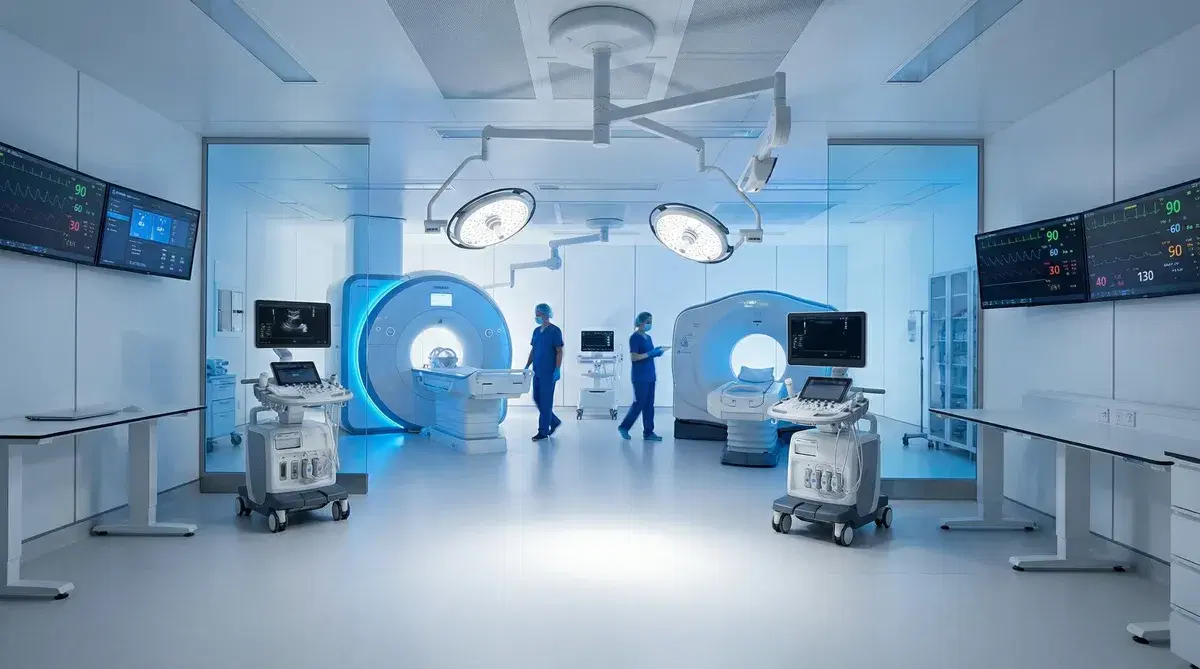
Medical equipment audit & asset verification
Ward-by-ward verification and tagging for NHS trusts and private providers — clinical engineering records, the fixed asset register and the physical estate finally telling the same story.
Healthcare estates hold the most mobile asset population of any sector. Infusion pumps, monitors, beds and wheelchairs move between wards daily; equipment libraries lend and lose; community devices sit in patients’ homes for weeks. The result is predictable: clinical engineering knows about devices finance has never capitalised, finance depreciates devices nobody can find, and clinical staff time is burned hunting for equipment that exists — just not where any system says it is. On a large acute site the same model of infusion pump can appear in three databases with three different counts, and none of them is right.
CPCON delivers medical equipment audits for NHS trusts and private providers: a physical, device-by-device verification of the estate, durable tagging that survives clinical cleaning regimes, and a three-way reconciliation between what exists, the EBME / clinical engineering database and the fixed asset register. The MHRA’s Managing Medical Devices guidance expects organisations to maintain records of the devices they hold and to manage them safely across their life, and CQC assessment frameworks expect equipment to be properly managed and available for care — an accurate, evidenced inventory is the foundation under both. To be clear about roles: regulators and auditors make those judgements, not us; what CPCON provides is the verified field data they sample. Across 30+ years and more than 4,500 verification and inventory projects, our own teams have done exactly this work in live clinical environments — see our experience and the underlying fixed asset verification service.
Why medical equipment registers go wrong
Healthcare asset data fails in ways that are specific to a hospital and almost impossible to fix from a desk. Knowing the failure modes is what lets us design a count that actually corrects them:
| Failure mode | How it happens | Why it matters |
|---|---|---|
| Devices maintained but never capitalised | Bought from a local or charitable budget, entered in EBME, missed by finance | Asset base understated; capital charge and insurance wrong |
| Devices depreciated but long disposed | Scrapped or condemned without a disposal entry | Ghost assets inflate the register and overstate value |
| Serial mismatches between systems | Manual keying, model-vs-serial confusion, transcription | Field safety notices and recalls become slow and uncertain |
| Mobile devices lost between wards | Pumps and monitors migrate; library loans not returned | Over-purchasing to compensate; clinical time wasted searching |
| Ownership category confused | Loan, lease, managed-service and consignment items intermixed | Double-counting; wrong items sent for disposal or write-off |
Each of those is a different reconciliation outcome with a different owner — finance, EBME, procurement or the ward — which is why our output is a set of routed, posting-ready schedules rather than a single undifferentiated list.
What a healthcare engagement covers
Medical devices & equipment
Diagnostic, monitoring, therapeutic and mobility equipment verified by serial and model, ward by ward, including equipment library and pooled stock.
Three-way reconciliation
Physical findings matched to the clinical engineering (EBME) database and the fixed asset register — discrepancies documented and routed, not averaged away.
Clinical-safe tagging
Medical-grade labels and placement rules agreed with clinical engineering; RFID options for theatres, libraries and high-loss device classes.
Estates & non-clinical assets
Beds, patient-handling equipment, IT, catering, estates plant and furniture captured in the same visit, so the whole site is verified once instead of twice.

The equipment categories we verify
A hospital’s asset base spans a wide range of device types, and each behaves differently in an audit — some are fixed and easy to find, others move constantly and demand a different approach. We verify across the full range, by serial and model, and record each in the category that drives how it is counted, tagged and maintained.
| Category | Typical devices | Audit characteristic |
|---|---|---|
| Diagnostic & imaging | Ultrasound, X-ray, endoscopy, analysers | Often fixed or room-based; access via radiology schedules |
| Monitoring | Patient monitors, telemetry, pulse oximeters | Highly mobile; strong RFID candidate |
| Therapeutic & life-support | Infusion pumps, syringe drivers, ventilators, defibrillators | High value, high mobility, safety-critical traceability |
| Mobility & patient handling | Beds, hoists, wheelchairs, trolleys | Move between wards; frequently under-recorded |
| Theatre & sterile services | Anaesthetic machines, diathermy, surgical equipment | Restricted access; scheduled around lists |
| Estates & non-clinical | IT, catering, laundry, estates plant, furniture | Captured in the same visit to verify the site once |
Capturing the category alongside the serial and location is what lets the same audit serve several purposes at once — fleet analysis for the capital programme, traceability for safety actions, and a clean register for finance — without re-surveying the wards for each.
Aligned to MHRA Managing Medical Devices
The MHRA’s Managing Medical Devices guidance is the reference point for how UK organisations are expected to look after the devices they own across the whole lifecycle — acquisition, acceptance, use, maintenance, and decommissioning. Several of its expectations rest directly on knowing what you have:
- A maintained device inventory. The organisation should hold a record of the medical devices it is responsible for. A verified, reconciled inventory is precisely that record, kept honest against the physical estate rather than drifting.
- Traceability for safety actions. When a Field Safety Notice or recall lands, you need to know — quickly — which specific units you hold, by serial and location. Serial-level verification and a clean register turn that from a paper-chase into a query.
- Maintenance and acceptance evidence. Devices should be accepted into service and maintained on a schedule. Our reconciliation against the EBME database highlights devices in use that the maintenance system does not know about — the gap where unscheduled, unverified equipment hides.
- Controlled decommissioning. Devices removed from service should be recorded as such. Ghost-asset cleanup gives both finance and EBME a documented end-of-life event, with date and photograph, instead of a silent disappearance.
CPCON does not certify compliance with the guidance and does not replace your medical devices management committee or EBME function — we strengthen the inventory those functions depend on. You can read the guidance directly from the MHRA on GOV.UK.
CQC, well-led and the evidence of good asset management
The Care Quality Commission assesses whether services are safe, effective, caring, responsive and well-led. Asset and equipment management surfaces under more than one of those: equipment must be available, suitable and properly maintained for safe care, and the governance of it is part of being well-led. Inspectors and internal auditors do not ask to see a marketing claim — they ask to see records: the inventory, the maintenance evidence, the ability to act on a safety alert. A reconciled, photographed, serial-level register is the artefact that answers those requests on the spot. As with every regulator we reference, the rating and the judgement are the CQC’s; what we supply is the verified data underneath it, and we never represent our work as conferring or guaranteeing a rating.
Calibration, maintenance and the limits of our role
A clear boundary keeps the engagement safe and useful. CPCON verifies, identifies and tags; we do not calibrate, test, repair or modify clinical equipment — those activities stay entirely with your EBME / clinical engineering team or your maintenance provider. What the audit does for the maintenance world is give it a reliable denominator. When the verified field inventory is reconciled to the maintenance database, three things become visible:
- Devices in use but not under any maintenance regime — the highest-risk gap, because an unmaintained device in clinical use is exactly what both MHRA guidance and CQC expectations are concerned with.
- Maintenance records for devices that no longer exist — effort and scheduling spent on ghost equipment.
- Location and custodian data that lets planned maintenance and recalls actually find the device, instead of the engineer arriving at a ward where the pump left a fortnight ago.
We do not store or schedule the calibration itself — we make the list it runs against trustworthy.
Equipment lifecycle: from acceptance to disposal
Medical equipment has a long, expensive life, and the register should reflect every stage of it. A good inventory is not a year-end photograph — it is the spine of lifecycle management.
| Lifecycle stage | What the register should capture | What verification fixes |
|---|---|---|
| Acquisition & acceptance | Capitalisation, serial, ownership category, in-service date | Catches devices accepted clinically but never capitalised |
| In-service use | Current location, custodian, condition | Replaces stale or blank location data with verified fact |
| Maintenance & calibration | Link to EBME record (we mirror, not manage) | Surfaces in-use devices with no maintenance record |
| Replacement planning | Age and condition grade across the fleet | Turns ad-hoc replacement into a costed capital plan |
| Decommissioning | Disposal date and evidence | Clears ghost assets from both finance and EBME records |
The cost of an inaccurate medical equipment register
In healthcare the consequences of a drifted register are both clinical and financial, and that dual cost is what makes the audit worth doing properly. Clinically, a register that cannot tell you which serial numbers you hold and where slows down every response to a Field Safety Notice or recall — the one moment when speed and certainty matter most. Operationally, mobile devices that no system can locate get replaced rather than found, so trusts over-purchase pumps and monitors to compensate for ones that are simply in the wrong ward, and clinical staff burn time searching that should be spent on patients. Financially, ghost devices inflate the asset base and the capital charge, devices accepted clinically but never capitalised understate it, and the whole position becomes hard to defend at audit. None of these is solved by a desktop tidy-up; all of them are solved by a physical, serial-level count reconciled to both the EBME database and the register.
What a clean medical equipment record looks like
We work to a concrete data standard so “accurate” means something testable. For every device in scope, the verified record carries:
- A clinical-safe asset tag physically present, mirroring the existing EBME number where one already exists.
- Manufacturer, model and serial number read from the device, so recalls and safety notices are traceable to the exact unit.
- Device type and clinical category (diagnostic, monitoring, therapeutic, mobility, life-support) for fleet analysis.
- A verified location down to ward, department or library — not a stale base-ward assumption.
- An ownership and funding category: owned, leased / right-of-use, managed-service, loan or consignment.
- A condition and age indication to support impairment review and capital replacement planning.
- A reconciliation status against both EBME and finance, routed to the right owner to action.
- A dated photograph in the evidence file, time-stamping the device’s existence on the audit date.
That attribute set is what turns a count into an asset-management baseline the trust can keep using — for recalls, for maintenance assurance, for the capital programme and for the year-end audit — without re-surveying the wards each time.
RFID for mobile and high-loss device classes
Some device classes defeat a periodic count by their nature: infusion pumps, syringe drivers, vital-signs monitors, telemetry, bladder scanners and library equipment move constantly and disappear regularly. RFID asset tracking is what makes those classes continuously countable rather than annually estimated. Tagged devices can be read in bulk by a handheld reader swept down a corridor or store room — dozens of assets in seconds — and fixed readers at equipment-library doors and theatre entrances can flag movement, so a pump that leaves the library is recorded leaving rather than discovered missing months later. For an equipment library in particular, RFID changes the economics entirely: the daily reconciliation of what is out, what is back and what is overdue stops being a manual chase and becomes a scan. We specify medical-grade, clinically cleanable RFID labels and agree placement with clinical engineering so a tag never compromises a device, and we mirror existing EBME numbers so there is one identity for the device, not two competing ones.
A clear boundary: what we do and what stays with you
Trust in a clinical setting depends on a boundary that is explicit and never crossed. It is worth stating plainly in both directions.
| CPCON does | CPCON does not |
|---|---|
| Physically verify, identify and photograph devices | Test, calibrate, repair or modify any device |
| Apply clinical-safe tags to agreed placements | Open, dismantle or interfere with a device’s function |
| Record asset attributes (model, serial, location, condition) | Connect to medical devices or the clinical network |
| Reconcile to EBME and finance, and route exceptions | Access, store or process any patient data |
| Supply the verified inventory regulators and auditors sample | Grant or guarantee a CQC rating or an audit opinion |
Multi-site trusts and group estates
Large NHS trusts, integrated care systems and private hospital groups rarely have one site to count — they have several, often with different local practice in clinical engineering and finance. We deliver these as a single programme: one method statement, one data standard and one reconciliation logic applied site by site, in planned waves around clinical schedules, so the consolidated inventory is genuinely comparable at group level rather than a set of site lists built to different rules. Between full audits, a cycle counting programme keeps the highest-mobility device classes accurate, so the next full audit confirms rather than rebuilds.
Designed for clinical environments
Counting in a hospital is an operational discipline before it is an accounting one. Our teams are inducted to local policies, work under the access arrangements agreed with ward managers, follow infection prevention and control procedures, and plan restricted areas — theatres, critical care, radiology — around clinical schedules. Verification is strictly non-invasive: we identify, photograph and tag; we never test, open or move clinical equipment without staff present, and we step out the moment clinical activity requires the space. Tag placement is agreed with clinical engineering so a label never sits over a sensor, vent, screen or moving part, and the materials are specified to survive the disinfection the device will be subjected to for years.
Scheduling is the practical art of a hospital audit. The highest-traffic clinical areas are worked when they are quietest — theatres between lists or early morning, day units before they open, outpatient suites around clinic times — and the team flexes ward-to-ward so it follows the path of least disruption rather than a rigid floor plan. Where an area cannot be accessed during the visit because of an emergency or an unexpected list, it is deferred and picked up later rather than rushed, because an audit that gets in the way of care has failed regardless of its data quality. This is the sort of operational judgement that distinguishes a team that has done this in live clinical settings many times from one that has not, and it is why every healthcare engagement is delivered by CPCON’s own experienced field teams rather than a franchised crew.
NHS trusts and private providers: same discipline, different drivers
The verification method is identical across the sector, but what the data is for differs, and we shape the reporting accordingly.
- NHS trusts and integrated care systems. The emphasis is on the medical devices inventory, maintenance assurance, recall traceability and capital-charge accuracy across large multi-site estates with high device mobility and equipment libraries. Verified location and condition data also support capital replacement planning, where ageing-equipment business cases live or die on the quality of the underlying fleet data.
- Private hospitals and clinic groups. The same clinical-inventory needs sit alongside sharper financial-reporting drivers: depreciation and impairment under FRS 102, on-balance-sheet lease accounting (Section 20) for the large amount of leased and managed-service equipment private providers run, and asset values that matter for transactions, refinancing and group reporting.
The hard cases: libraries, loans and community devices
Three populations cause more register error in healthcare than all the rest combined, and each needs handling on its own terms during the audit rather than being forced into a simple ward count.
- Equipment libraries and pooled stock. A medical equipment library is, by design, a population that is constantly out on loan, so a snapshot count taken at any single moment under-states what the trust owns. We verify against the library record, reconcile what is out, what is back and what is unaccounted for, and where loss rates justify it we recommend RFID at the door so the library can reconcile itself daily instead of annually.
- Loan, managed-service and consignment equipment.Devices on the floor that the trust does not own — manufacturer loans, managed-service fleets, consignment implant stock — must be identified and excluded from the owned register, because counting them as assets over-states the balance sheet and risks sending a supplier’s property for disposal. Ownership category is captured for every device precisely so these never get mixed in.
- Community and home-based devices. Equipment issued to patients in their own homes, or held across community clinics and health centres, sits outside the acute site entirely. We agree how this population is treated in scoping — verified at point of issue and tracked through the issuing record rather than physically re-counted in every home — so it is neither double-counted nor quietly dropped.
Benefits a verified estate unlocks
The audit is a means, not an end. Once the inventory is verified and reconciled, several things that were previously difficult become routine, and it is worth being explicit about them because they are the reason the work pays for itself:
- Faster, more certain recall response, because the trust can identify the exact affected serials and their locations in minutes.
- Maintenance assurance, because in-use devices missing from the maintenance schedule are surfaced and can be brought into the regime.
- Better capital planning, because age and condition data across the fleet turns ageing-equipment business cases into evidence-based bids.
- Reduced over-purchasing, because devices that were being replaced when they were merely lost can now be found.
- Cleaner accounts, because ghost assets leave the register and uncapitalised devices join it, correcting depreciation, capital charge and insured values.
- A year-end that confirms rather than scrambles, because the existence evidence auditors sample already exists.
Where the data goes next
The financial outputs matter as much as the operational ones. Verified data feeds the fixed asset register with real locations, conditions and existence evidence — supporting depreciation, impairment review of idle or unserviceable devices, insurance values and, for private providers, on-balance-sheet lease accounting. For estates that lose mobile devices faster than they can count them, RFID asset tracking on pumps, monitors and library equipment makes continuous counting realistic — a reader at a library door or theatre entrance flags movement, and a routine ward scan replaces the annual hunt. Professional asset tagging gives every future audit a scannable starting point, and a cycle counting programme keeps high-mobility device classes accurate between full audits. IT-heavy estates can fold the biomedical and clinical-IT device fleet into the same programme via our IT asset inventory service, under your information-governance rules.
From inventory to procurement and standardisation
A verified, categorised fleet record is not only an accounting and safety asset — it is a procurement one. Once a trust or group can see every device it owns by make, model, age and condition across all sites, two opportunities open up that a fragmented record hides. First, standardisation: estates that have grown by acquisition or piecemeal purchasing often run many models of the same device type, multiplying the training burden on clinical staff, the spares the EBME team must hold and the maintenance contracts in force. The fleet view makes the case for consolidating onto fewer models concrete. Second, replacement planning: age and condition data across the fleet turns the perennial ageing-equipment business case from an assertion into evidence, so capital bids can be prioritised on real risk rather than on whichever ward shouts loudest.
None of that is possible from a register that cannot say with confidence what exists and where. The audit is what makes the procurement and capital conversations evidence-based — and it is the same verified dataset that already serves finance, safety and the year-end audit, used again rather than rebuilt.
Information governance and data security
Working in a healthcare estate means working inside an information-governance regime, and we are designed to fit it rather than challenge it. The decisive point is that a medical equipment audit does not require patient data at all: the records we produce describe assets — manufacturer, model, serial, location, condition, ownership — not patients. Our teams do not connect to medical devices, do not access the clinical network, and do not view, capture or process any patient-identifiable information. Where a ward is occupied, photography is of the equipment, and our staff work under the same confidentiality expectations as any contractor on site, stepping out whenever clinical activity requires the space.
For the parts of the estate where clinical IT, biomedical devices and networked equipment overlap, that scope is handled separately under your information-governance rules through our IT asset inventory approach — keeping the device-asset record cleanly distinct from anything touching clinical data. The aim throughout is a verified inventory that strengthens governance and assurance without ever becoming a data-protection concern in its own right.
What you receive
- A verified, photographed, serial-level medical equipment inventory, ward by ward.
- Three-way reconciliation classifying every device against EBME and finance: matched, in-use-not-capitalised, capitalised-not-found, serial mismatch.
- A ghost-asset disposal pack routed to finance and EBME, with date and photographic evidence.
- Ownership-category flags: owned, leased / right-of-use, managed-service, loan and consignment.
- Clinical-safe tagging applied in the same visit, mirroring existing EBME numbers where present.
- Condition and age data across the fleet to support capital replacement planning.
- An optional RFID baseline for high-mobility and high-loss device classes.
Every UK healthcare engagement is delivered by CPCON’s own senior methodology and field teams — not a franchised count crew — with the discretion and clinical awareness live wards demand. If your equipment register, your maintenance system and your wards are telling three different stories, the audit is what makes them agree. See how the same verification discipline applies in other sectors such as manufacturing and financial services, or return to the industries overview.
Frequently asked questions
Can you verify equipment on live wards?
Yes — that is the normal case. Teams work ward by ward under the supervision arrangements agreed with nursing and estates leads, following local infection prevention and control procedures, stepping out whenever clinical activity requires. Theatres, critical care and other restricted areas are scheduled through their managers, often early morning or between lists, so the audit fits around patient care rather than the other way round.
Will tagging interfere with devices or cleaning regimes?
No. We specify medical-grade label materials that withstand clinical disinfection, place tags away from sensors, vents and moving parts following placement rules agreed with clinical engineering, and never open or modify a device. Tagging is identification only — maintenance, calibration and safety testing remain entirely with your EBME / clinical engineering function. Where a device already carries an EBME asset number we mirror it rather than competing with it, so there is one identity, not two.
Do you reconcile against our clinical engineering (EBME) database as well as finance?
Yes — that three-way reconciliation is the core of the engagement. Devices found on site are matched by serial to both the EBME / clinical engineering database and the fixed asset register. The typical findings: devices maintained but never capitalised, devices depreciated but disposed of years ago, and serial mismatches that make recalls and safety alerts harder than they should be. Each category is reported with a posting-ready schedule.
How do you handle leased, loaned and consignment equipment?
We flag the ownership category for every device found: owned, leased (increasingly on-balance-sheet as right-of-use assets under FRS 102 Section 20 for private providers), managed-service equipment, supplier loan and consignment stock. Mixing these up is one of the commonest causes of register errors and double-counting in healthcare estates, and it matters operationally too — you cannot send a loan pump for disposal or a consignment item for write-off.
Does an equipment audit support MHRA and CQC expectations?
It supports the records foundation both rest on. The MHRA’s Managing Medical Devices guidance expects organisations to know what devices they hold, where they are and that they are maintained, and CQC well-led and safe-care assessments expect equipment to be properly managed and available. We do not grant or guarantee any rating — those judgements belong to the regulator and to your auditor — but an accurate, evidenced, reconciled inventory is the data layer underneath both, and it is exactly what an inspection or internal audit asks to see.
How do you avoid touching patient data or the clinical network?
By staying off it. Verification is physical: we identify, photograph and tag equipment and record asset attributes (model, serial, location, condition, ownership). We do not connect to medical devices, the clinical network or any patient-data system, and the asset records we produce contain no patient information. Where the estate also holds clinical IT and biomedical devices with a network footprint, that scope is handled through our IT asset inventory approach under your information-governance rules, separately from clinical data.
Can a single visit cover clinical and non-clinical assets?
Yes, and it usually should. Beds, patient-handling equipment, IT, catering, estates plant and furniture sit in the same buildings as the clinical devices, so verifying them in the same visit means the whole site is counted once instead of twice. Clinical and non-clinical findings are reported separately but captured together, which keeps disruption to wards to a single planned pass.
Plan a medical equipment audit
Tell us about your sites and asset volumes — we respond within one business day with a scoped proposal.
Request a Proposal