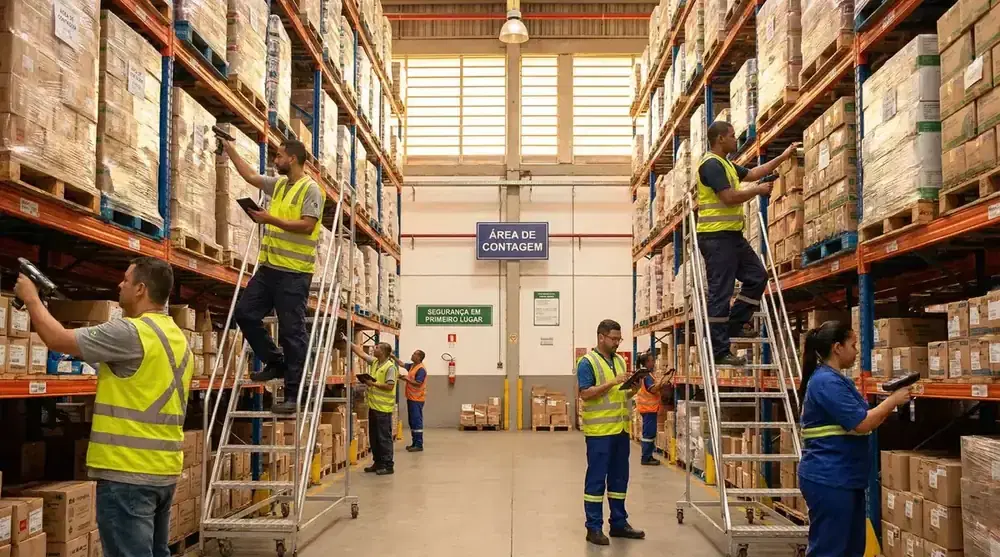
Stock reconciliation: where counts become truth
Counted quantities matched to your ERP or WMS line by line, variances investigated by cause before posting, and adjustments governed with a full audit trail.
Counting is the easy half. The value of a stocktake is created — or destroyed — in what happens next: how counted quantities are matched against the book, how differences are investigated, and how adjustments are authorised and posted. Skip that discipline and the same count data produces phantom write-offs, hides real theft inside gross noise, and teaches the organisation that “the system is always wrong anyway”.
Stock reconciliation is CPCON’s home ground — the book-to-physical discipline we have refined across 4,500+ projects. We freeze the book position at a documented cut-off, match every counted line to it, investigate variances in a defined cause hierarchy, and hand finance an adjustment schedule where every line carries its evidence. The deliverable is not a number; it is a number that survives questioning.
The reconciliation discipline
Cut-off control
Book extract frozen at an agreed timestamp; goods-in, goods-out and works orders during the count window logged and reconciled as cut-off items.
Line-by-line matching
Counted quantities matched to book by SKU and location — site totals that “net off” are exactly how location chaos hides.
Cause-coded variances
Each material variance classified: location error, UoM mismatch, cut-off timing, master data fault, damage/waste, or genuine unexplained loss.
Governed adjustments
Tiered authorisation by value, every posting referenced to its investigation — the audit trail behind the adjustment journal.
What book-to-physical reconciliation really is
Every business that holds stock runs two inventories in parallel: the physical one on the shelves and in the racks, and the logical one in the ERP or WMS. The book position is what the system believes exists, built up from receipts, issues, transfers and adjustments. The physical position is what a count actually finds. They are never identical, because every transaction is a chance to introduce error, and the gap between them is the reconciliation’s entire subject.
Book-to-physical reconciliation is the disciplined process of closing that gap honestly. It is not simply overwriting the system with the count — that would bury information and post unexplained losses straight to the P&L. It is the deliberate work of comparing the two positions line by line, understanding why each difference exists, correcting the records to physical reality, and recognising in the accounts only the losses that are real. The physical count is the input; the reconciled, explained, posted position is the output. One is data; the other is truth.
Why physical and logical drift apart
Stock records decouple from reality for a long list of mundane reasons, almost none of which are theft. Understanding the catalogue of causes is what stops a business reaching for the “loss” explanation by default and writing off stock that is sitting one bay over. The common drivers are:
- Receiving errors. Deliveries booked in at the wrong quantity, against the wrong SKU, or to the wrong location.
- Picking and despatch errors. The wrong item or quantity shipped, or shipped and not relieved from the system.
- Put-away and location errors. Stock physically moved without a corresponding system transfer, so it exists but in the “wrong” bin.
- Unit-of-measure confusion. Cartons, inners and eaches mixed up at receipt or count, multiplying or dividing the true quantity.
- Master-data faults. Duplicate SKUs for one physical product, inflating one line and starving the other.
- Cut-off timing. Movements straddling the count freeze, counted on one side but recorded on the other.
- Unrecorded movements. Real transfers, samples, returns or consumption that simply never got keyed.
- Unrecorded loss. Damage, waste, spoilage and expiry that happened but was never written down at the time.
- Genuine shrinkage. Internal and external theft, and supplier short-delivery — the residue once everything else is explained.
Gross versus net variance — why we never net off
One methodological choice does more than any other to determine whether a reconciliation finds problems or hides them: whether variances are allowed to net off. Net variance lets a surplus in one location cancel a shortfall in another. It is seductive because it makes the headline number small — but a site that is perfectly balanced on net can be in complete disorder underneath, with stock scattered into the wrong bins and any theft neatly masked by the offsetting surplus somewhere else.
We reconcile on gross variance, line by line and location by location. Every difference is counted at its absolute size, regardless of direction, so a thousand-unit surplus and a thousand-unit shortfall are two problems to investigate, not a tidy zero. This is the single discipline that exposes location chaos and concealed loss, and it is why a CPCON reconciliation routinely surfaces issues that a netted site total had been quietly averaging away for years.
The variance hierarchy
Investigation runs cheapest-explanation-first, and each step is documented so the residue genuinely deserves the label “unexplained”:
- Location errors — the unit exists, one bin over. Corrected, not written off; fed back to put-away process quality.
- Unit-of-measure and pack faults — cartons, inners and eaches confused in the master file; a data fix, not a loss.
- Cut-off timing — movements straddling the freeze, matched against the movement log from the count window.
- Master data duplicates — the same physical item living under two SKUs, inflating one and starving the other.
- Known operational loss — damage, waste and expiry that happened but never got recorded at the time.
- Genuine unexplained loss — what remains. This is the real shrinkage figure, and the input to a proper shrinkage investigation.
Set out as a reference, the full cause taxonomy and its resolution looks like this — and every line of a CPCON reconciliation is tagged to one of these codes before anything is posted:
| Cause | What it looks like | Resolution |
|---|---|---|
| Location / put-away error | Stock exists, in a different bin than recorded | Corrected in place; feed back to put-away quality |
| Unit-of-measure / pack fault | Cartons, inners and eaches confused in the master | Data fix in the item master; not a loss |
| Cut-off timing | Receipt or despatch straddling the freeze | Matched to the count-window movement log |
| Master-data duplicate | One physical item living under two SKUs | Merge or correct master; rebalance both lines |
| Recorded vs unrecorded movement | A real movement never keyed into the system | Post the missing transaction; fix the discipline gap |
| Known operational loss | Damage, waste or expiry that was never recorded | Recognise the loss; tighten the recording process |
| Count error | Miscount on the floor | Resolved by blind recount before posting |
| Genuine unexplained loss | What remains after all of the above | The true shrinkage figure; input to investigation |
The reconciliation process, step by step
A reconciliation is a sequence, and the order matters: each step protects the integrity of the ones after it. Skip the cut-off and the matching is meaningless; skip the investigation and the posting is a guess. This is the workflow we run, and the one we document so it survives staff turnover and stands up to audit.
| Step | What happens |
|---|---|
| 1. Freeze the book | Export the system stock position at a documented cut-off timestamp. |
| 2. Capture cut-off movements | Log every goods-in, goods-out and works order during the count window. |
| 3. Match line by line | Reconcile counted quantities to book by SKU and location, on gross variance. |
| 4. Investigate by cause | Work the variance hierarchy cheapest-explanation-first; document each step. |
| 5. Recount where needed | Trigger blind recounts on out-of-tolerance lines before accepting them. |
| 6. Authorise and post | Tiered sign-off by value; every adjustment referenced to its evidence. |
| 7. Report and feed back | Adjustment schedule, residual shrinkage figure, and causes returned to the operation. |
Accounting adjustments and FRS 102
A reconciliation ends in the ledger. Once variances are investigated and authorised, the records are corrected to the physical position and the genuine difference is recognised in the profit and loss account — usually as an inventory or cost-of-sales adjustment. Condition matters as much as quantity: under FRS 102, inventories are measured at the lower of cost and estimated selling price less costs to complete and sell, so damaged, obsolete and slow-moving stock identified in the count drives a write-down rather than sitting on the books at full cost.
The discipline that makes those entries safe is traceability. Every adjustment carries its cause code, its investigation note and a reference back to the count records, so the adjustment journal is an auditable document rather than a black box where inconvenient numbers go to disappear. CPCON produces the adjustment schedule and the supporting evidence; the accounting treatment — the journals, the provisions, the disclosures — remains your finance team’s and your auditor’s to own. We are not an audit firm and issue no opinion; what we supply is the independent, documented basis on which the entries can be made and defended.
Not every adjustment is a loss, and conflating the four kinds is one of the commonest reasons a reconciliation overstates the hit to the P&L. A disciplined adjustment schedule classifies every line into one of four treatments, because each carries a different accounting consequence under FRS 102 — and two of them touch the profit and loss account not at all:
| Adjustment type | When it applies | FRS 102 treatment |
|---|---|---|
| Write-on (positive adjustment) | Physical count exceeds book — found stock, an under-booked receipt or an unrecorded return | Increases the carrying value of inventory; recognised as a credit to cost of sales. Still measured at the lower of cost and net realisable value under FRS 102 s.13 — a write-on cannot lift stock above cost. |
| Write-off (loss adjustment) | Physical count falls short of book, with no recoverable explanation — genuine shrinkage, theft or destroyed stock | Reduces inventory and is charged to the P&L in the period. FRS 102 s.13.19 requires the loss to be recognised as an expense when the stock is written down or written off; the residual unexplained figure feeds the shrinkage investigation. |
| Reclassification | Stock physically present and correct in total, but sitting under the wrong SKU, location, condition grade or ownership flag | Value-neutral to the P&L: one line is debited and another credited. No loss is recognised — the work is master-data and location correction, not an accounting hit, though it must still be evidenced. |
| Provision (impairment) | Stock that exists but whose value is impaired — damaged, obsolete, slow-moving or past shelf-life — identified by condition during the count | A write-down to net realisable value rather than a full write-off, recognised as an allowance under FRS 102 s.13.19. Reversed in a later period if the NRV recovers (s.13.20), which a full write-off cannot be. |
The practical point is that a reconciliation which sorts variances into these four buckets posts far less to the loss line than one that treats every difference as shrinkage. Reclassifications net to zero; write-ons offset write-offs where the same stock simply moved SKU or location; provisions preserve the option to reverse if value recovers. Only the genuine, unrecoverable shortfall becomes a write-off — and that is the number worth chasing.
Governance: who authorises adjustments
The adjustment journal is one of the most sensitive controls in a stock operation, because it is where a genuine loss and a buried problem look identical on the page. Two principles keep it honest. First, separation of duties: the people who counted do not authorise the adjustments arising from their own count. Second, tiered authorisation by value: small variances cleared at supervisor level, larger ones escalating to a finance manager and material ones to a controller or above. Each tier sees the investigation note, not just the number.
This governance is not bureaucracy for its own sake — it is exactly what an auditor tests, and exactly the control that prevents the adjustment journal from becoming the place where shrinkage, mis-management and the occasional fraud are quietly written off without scrutiny. A reconciliation with a clean, tiered authorisation trail is one a board, an auditor and a lender can all trust.
Segregation of duties is only as strong as the record that proves it held. The control that an auditor actually tests is not the policy on paper but the trail in the system: who counted, who investigated, who authorised at which tier, and when — each step time-stamped, attributed to a named individual, and impossible to alter after the fact. A genuine audit trail captures the before-and-after quantity of every line, the cause code applied, the investigation note attached, and the authorising identity, so that any adjustment can be reconstructed months later from the evidence alone. Where the same person appears as both counter and authoriser on a line, the trail flags it — the absence of segregation becomes visible rather than silent. This is the difference between a control that exists and a control that can be demonstrated: the first reassures management, the second satisfies an audit, and only the second survives the moment a material adjustment is challenged.
From reconciliation to prevention
The best reconciliation makes itself smaller next time. Because every variance is coded by cause, the accumulated pattern is a diagnostic of where the operation leaks accuracy — a receiving step that mis-books a particular supplier, a unit-of-measure fault that recurs on a product family, a put-away discipline problem on a specific aisle. Treated as a one-off true-up, that intelligence is thrown away and the same write-off returns next period. Fed back into the operation, it eliminates the cause and the variance does not come back.
Prevention is therefore the natural extension of reconciliation, and it runs along two tracks: tightening the processes that generate error (receiving, put-away, recording discipline, master-data hygiene), and counting more frequently so problems are caught while small. That second track is cycle counting, and the genuine-loss residue a reconciliation isolates is the precise input to a structured shrinkage control programme.
That residual number matters beyond operations. Year-end stock is an audited balance: Companies Act 2006 s.386(4) requires the statements of stocktakings behind it, and your auditor — attending counts under ISA (UK) 501 — will trace adjustments back through exactly the trail described here. A reconciliation file with cause-coded variances and authorised postings turns that test into a formality.
Reconciling to the ERP and WMS
Reconciliation lives or dies on data, and the system the count is matched against shapes the whole exercise. Most operations run an ERP (the financial and master system of record) alongside, or integrated with, a WMS (the operational stock and location system). The two do not always agree with each other, let alone with the physical stock, and a reconciliation often has to resolve a three-way relationship: physical, WMS and ERP.
The first discipline is a clean, frozen extract at the documented cut-off — not a live query that keeps moving as the count proceeds. The second is matching at the right granularity: by SKU and location against the WMS, then rolling to the value position in the ERP, so a location-level error is not lost when figures are aggregated upward. The third is master-data hygiene, because duplicate SKUs, stale units of measure and orphaned location codes are among the most common sources of apparent variance — and they are data fixes, not stock losses. We are comfortable working against the major ERP and WMS platforms and, where the relationship between systems is itself the problem, the reconciliation will say so rather than paper over it.
Multi-warehouse, 3PL and stock in transit
A single-site reconciliation is hard enough; a network of warehouses adds a dimension that single-site logic simply cannot see — stock that belongs to the business but is, at the cut-off moment, in neither the location it left nor the one it is heading to. Goods on a trunk vehicle between regional depots, a transfer booked out of one site but not yet receipted at the next, a return in the reverse-logistics stream: each is a real unit with a real value that a naive count, taken site by site, will record as a shortfall at origin and a surplus at destination, or miss entirely. Reconcile each warehouse in isolation and the network appears to be leaking stock when in fact it is merely moving it.
The discipline that resolves this is a network-level cut-off rather than a series of local ones. We freeze the book position across every site at the same documented timestamp, then build an in-transit register from the inter-warehouse transfer orders that are open at that instant — despatched-not-received lines, in effect a third location the system recognises but no shelf holds. Each network count is matched not against its own four walls but against the consolidated position: physical stock at every site, plus the in-transit register, reconciled to the group book. A unit on a lorry is then accounted for as exactly what it is, not double- counted as a loss at one end and a windfall at the other.
Third-party logistics sharpens the in-transit problem, because the operator who physically holds the stock is not the party who owns it, and the two run separate systems that drift apart in their own right. A 3PL reconciliation has to align three positions at once: the operator’s WMS, the owner’s ERP and the physical count. Stock moving between a client’s own site and the 3PL, or between two 3PL nodes, then sits in a grey zone where a despatched-not-received line can be a genuine loss or a pure timing artefact — and the register that distinguishes them is also what determines storage charges and stock-loss liability between the parties. Netting such a network site by site averages the in-transit noise away and leaves everyone arguing from a different number.
A worked example
The value of the discipline is clearest in a concrete case. Suppose a count of a fast-moving SKU returns 1,180 units against a book figure of 1,300 — an apparent shortfall of 120, which a naive process would write off as loss. The reconciliation works it cheapest-explanation- first. Sixty units are found in an adjacent pick face that was mapped to the wrong location: a put-away error, corrected in place, not a loss. Forty units trace to a goods-in receipt that was booked the morning after the cut-off but physically arrived before it: a timing artefact, matched against the count-window movement log. Ten units are explained by a unit-of-measure fault on a returns line, where an inner of ten was keyed as a single unit: a master-data fix.
That leaves ten units genuinely unaccounted for. Only those ten are the real shrinkage figure; the other 110 were never missing. A process that wrote off the full 120 would have overstated the loss elevenfold, taken an unnecessary hit to the P&L, and — worse — buried the genuine ten-unit problem inside the noise, where no investigation would ever find it. The reconciliation produces a small, honest adjustment, a clean trail of what each unit was, and a precise input to a shrinkage investigation that now has a real number to chase. That is the difference between data and truth, on a single line.
Reconciling counts you have already done
Not every reconciliation needs CPCON to do the counting. A large share of our reconciliation work starts from a client’s own raw count files — the output of an internal stocktake or a cycle count — which we then reconcile independently. It is a cost-effective middle path to audit-grade records: you keep the counting in-house, but the reconciliation, investigation and adjustment schedule carry the weight of an independent firm.
Working from your count data, we match it to the frozen book extract, reconcile on gross variance line by line, cluster the differences by cause, and — critically — surface count-quality problems the internal team could not see in their own work: sections that need recounting, tolerances that were breached without a recount, systematic patterns that point to a method fault rather than a stock loss. The output is the same governed adjustment schedule with supporting evidence that we produce from our own counts, at a fraction of the field cost. It is particularly valuable where an auditor has queried an internal count and you need an independent reconciliation to stand behind the numbers.
Reconciliation in different operations
The book-to-physical logic is constant, but what counts as a “variance” and how it is investigated shifts with the operation.
Warehouse & distribution
High throughput means location accuracy is as important as quantity accuracy, and most variances are movement-driven — mis-picks, mis-puts and cut-off timing rather than genuine loss. Reconciling at bin level, never on netted site totals, is what separates a warehouse that is merely busy from one that is genuinely out of control. The operational context is on our logistics & warehousing page.
Third-party logistics & consignment
When stock is held by one party and owned by another, reconciliation acquires a custody dimension: the count is reconciled against the owner’s SKU master and the contract terms, independently of both the owner and the operator. The reconciled position becomes the basis for settling custody disputes — which is precisely where independence stops being a nicety and becomes the deliverable.
Manufacturing
Manufacturing adds work-in-progress and bills of materials to the picture: a finished-goods variance can trace back to a component consumed but not recorded, or a yield assumption that no longer holds. Reconciliation here often has to follow the value chain, not just the shelf, and the cause hierarchy extends into production recording as well as warehouse movement.
The cost of getting reconciliation wrong
Skipping or rushing reconciliation is not a neutral saving — it has a direct, compounding cost, which is why the discipline pays for itself many times over. The failures cluster into four expensive outcomes:
- Phantom write-offs. Posting timing artefacts and location errors as real loss takes a hit to the P&L that should never have been recognised — a self-inflicted margin wound.
- Concealed theft. When real loss is averaged away inside netted totals or unexamined gross noise, genuine shrinkage carries on undetected behind the numbers.
- Eroded trust in the system. An organisation that sees unexplained adjustments learns to distrust its own records, and a stock figure nobody believes has to be re-verified before every decision.
- Audit and lender friction. Adjustments with no investigation trail are exactly what an auditor or an inventory-finance reviewer probes — turning a formality into a problem and, at worst, into a qualification or a covenant question.
Against those costs, a disciplined reconciliation is cheap. Catching the phantom write-off protects the margin; isolating the genuine loss starts the shrinkage investigation while it can still be solved; the clean adjustment trail makes the audit a formality; and the restored trust in the records lets the business act on its own numbers instead of constantly second-guessing them.
Why CPCON
Reconciliation is where many count providers stop short — they hand over count sheets and leave finance to make sense of the variances alone. It is where CPCON starts. More than 30 years and over 4,500 projects of physical-versus-logical work have made book-to-physical reconciliation our core discipline, delivered by our own teams rather than sub-contracted. We never net off, we code every variance by cause, we govern the adjustments with tiered authorisation, and we hand finance an adjustment schedule where every line carries its evidence and its trail back to the count. The result is the only deliverable that matters here: a stock position that survives the scrutiny of a board, an auditor, a lender or a court.
Reconciliation is built into every CPCON stocktake and every cycle counting programme we run — and where the situation calls for fully third-party evidence, it underpins our independent stock audit service. Distribution and retail teams will find the operational context on our logistics & warehousing and retail pages. The same book-to-physical logic applied to fixed assets is our fixed asset verification practice.
Frequently asked questions
What is a book-to-physical reconciliation?
The disciplined comparison of counted stock against the quantities your system believes exist — line by line, at an agreed cut-off — followed by investigation of the differences and a governed adjustment of the records. The count produces data; the reconciliation produces truth: which variances are real losses, which are location or timing artefacts, and what should actually be posted.
Why do so many “variances” turn out not to be losses?
Because most are bookkeeping artefacts, not missing stock: items found in a neighbouring bin, unit-of-measure mismatches (cartons counted as eaches), receipts or despatches straddling the cut-off, duplicate SKUs in the master file. A reconciliation that nets these out before posting protects the P&L from phantom write-offs — and stops real theft hiding inside noisy gross numbers.
Who should authorise stock adjustments?
Not the people who counted, and not unbounded. Good practice is tiered authorisation by value — supervisor, finance manager, controller — with every adjustment carrying its investigation note and reference back to the count records. That governance trail is what your auditor tests, and it is the control that stops the adjustment journal becoming a place to bury problems.
Can you reconcile counts we have already done ourselves?
Yes. We regularly take a client’s raw count files and run the reconciliation independently: matching to the frozen book extract, clustering variances by cause, identifying count-quality problems (sections that need recounting) and producing the adjustment schedule with supporting evidence. Independent reconciliation of an internal count is a cost-effective middle path to audit-grade records.
What is the difference between gross and net variance, and why does it matter?
Net variance is the figure you get when over-counts and under-counts are allowed to cancel each other across a site or category; gross variance adds up the absolute size of every difference regardless of direction. Net variance is dangerously reassuring: a location with a thousand units too many in bin A and a thousand too few in bin B nets to zero and looks perfect, while in reality the operation is in chaos and any theft is perfectly camouflaged. We reconcile on gross variance, line by line and location by location, because that is the only way location errors and concealed loss are exposed rather than averaged away.
How often should stock be reconciled?
At minimum, after every physical count — a count that is not reconciled and posted has produced data but changed nothing. Businesses running an annual stocktake reconcile annually; those running a cycle counting programme reconcile continuously, which is one of the reasons cycle counting holds accuracy so much better. The more frequent the reconciliation, the warmer the transaction trail when a variance is investigated, and the smaller and more explainable each difference is.
What accounting entries result from a stock reconciliation?
Once variances are investigated and authorised, the records are adjusted to the physical position and the difference is recognised in the profit and loss account — typically as a cost of sales / inventory adjustment, with write-downs for damaged, obsolete or slow-moving stock handled under the lower-of-cost-and-net-realisable-value rule in FRS 102. The key discipline is that every posting carries its investigation note and a reference back to the count records, so the adjustment journal is auditable rather than a black box. CPCON produces the adjustment schedule and evidence; your finance team and auditor own the accounting treatment.
How do you stop the same variances recurring?
By treating each reconciliation as a diagnostic, not just a true-up. Because every material variance is coded by cause, the pattern over time points at the process that is generating error — a receiving step, a unit-of-measure fault in the master file, a put-away discipline problem. Feeding those findings back into the operation is what turns reconciliation from a recurring repair into a permanent fix, and it is the bridge from reconciliation into a structured shrinkage-control programme.
How do you handle stock in transit between warehouses at the cut-off?
With a network-level cut-off and an in-transit register, not a series of separate site counts. We freeze the book position across every location at the same documented timestamp, then build a register of inter-warehouse transfers that are despatched but not yet receipted — a third, virtual location the system recognises but no shelf holds. Each count is reconciled against the consolidated position (physical stock at every site plus the in-transit register, matched to the group book), so a unit on a vehicle between depots is accounted for as exactly that, rather than recorded as a loss at origin and a windfall at destination. Reconcile each warehouse in isolation and a network that is merely moving stock looks like one that is leaking it.
Is every stock adjustment a write-off?
No, and treating them as if they were is one of the commonest ways a reconciliation overstates the hit to the P&L. There are four distinct treatments under FRS 102. A write-on is a positive adjustment where found stock or an under-booked receipt lifts the count above book. A write-off is the genuine, unrecoverable shortfall charged to the profit and loss account. A reclassification moves stock between SKUs, locations or condition grades with no net effect on the accounts at all. A provision is a write-down to net realisable value for impaired stock — damaged, obsolete or slow-moving — which, unlike a write-off, can be reversed if value later recovers. A disciplined schedule sorts every line into the right bucket, so only the real loss reaches the loss line.
How does reconciliation support an audit?
Year-end stock is an audited balance. Companies Act 2006 s.386(4) requires the statements of stocktakings behind it, and your auditor — attending counts under ISA (UK) 501 — will trace adjustments back through exactly the cut-off, matching and cause-coding trail a proper reconciliation creates. A reconciliation file with frozen cut-off, line-by-line matching, cause-coded variances and authorised postings turns that test into a formality. To be clear, CPCON is not an audit firm and issues no opinion; the certification or sign-off is the auditor’s, and we supply the independent field evidence behind it.
Get an independent reconciliation of your next count
Tell us about your sites and asset volumes — we respond within one business day with a scoped proposal.
Request a Proposal