
Warehouse stock counts that hold at bin level
Distribution centres, 3PLs and ports: book-to-physical reconciliation against the WMS, cut-off control while operations keep moving, and the MHE estate verified in the same visit.
Warehouses drift one transaction at a time. A mis-pick here, a short receipt booked as full there, a pallet put away one bay over — none of it visible day to day, all of it compounding until the WMS describes a warehouse that no longer exists. Pick rates fall, replenishment fires at the wrong time, customers receive short or wrong shipments, and the year-end count lands as a write-off nobody can explain.
CPCON counts distribution operations the way they actually run: bin-level counts sequenced around despatch cut-offs, goods-in and goods-out controlled and logged during the count window, and a line-by-line book-to-physical reconciliation against the WMS that separates location errors from genuine loss before anything is posted. Item accuracy and location accuracy are reported as two different numbers — because they are two different problems. The same field methodology has been applied across more than 4,500 inventory and fixed asset engagements in six countries; the full counting service is described under stocktaking services, and the wider track record on our experience page.
Built for distribution operations
Full-site & zoned counts
Bin-level counting in racked, bulk and automated areas, sequenced so operations resume zone by zone behind the count.
3PL client stock audits
Independent counts of client-owned stock — custody evidence for the 3PL, existence evidence for the client’s auditors.
WMS reconciliation
Counted quantities matched to the WMS line by line; location errors corrected on the spot, real variances reported with cut-off documentation.
MHE & site asset registers
Forklifts, racking, automation, dock equipment and IT verified and tagged — the fixed asset estate counted in the same visit.
Why warehouse stock records drift
No single failure breaks a stock record; it erodes through dozens of small, individually defensible transactions. Understanding the mechanisms matters, because the fix for each is different and a count that does not diagnose the cause simply resets the clock until the same drift returns.
- Putaway to the wrong location. The unit exists and the site total is correct, but the WMS points pickers at an empty bin. This is pure location error — invisible to a value-only count, lethal to pick rates.
- Receiving errors. A short or over receipt booked as the expected quantity, a mixed pallet split incorrectly, or a SKU received against the wrong line. The variance is created at the gate, long before anyone notices it at the pick face.
- Mis-picks and unrecorded returns. The wrong unit leaves on an order, or a customer return re-enters stock without a clean putaway. Both decouple physical reality from the system balance.
- Unit-of-measure confusion. Eaches counted as cases, inners booked as outers, catch-weight items recorded by piece instead of weight — a single conversion error multiplies across a high-volume SKU.
- Damage and write-offs not posted. Crushed or date-expired stock pulled from the pick face but never adjusted out of the system inflates book stock indefinitely.
- Genuine shrinkage. Theft, sampling, and process loss. This is the residual that remains once location errors and paperwork timing are stripped out — and it is the only category that should ever be treated as loss.
A reconciliation that lumps all of these into one “variance” number is worse than useless: it writes off location errors as shrinkage and hides genuine loss inside paperwork noise. Our reporting cause-codes every line so the operation can act on each category separately — a discipline carried through into stock reconciliation and, where loss persists, shrinkage control.
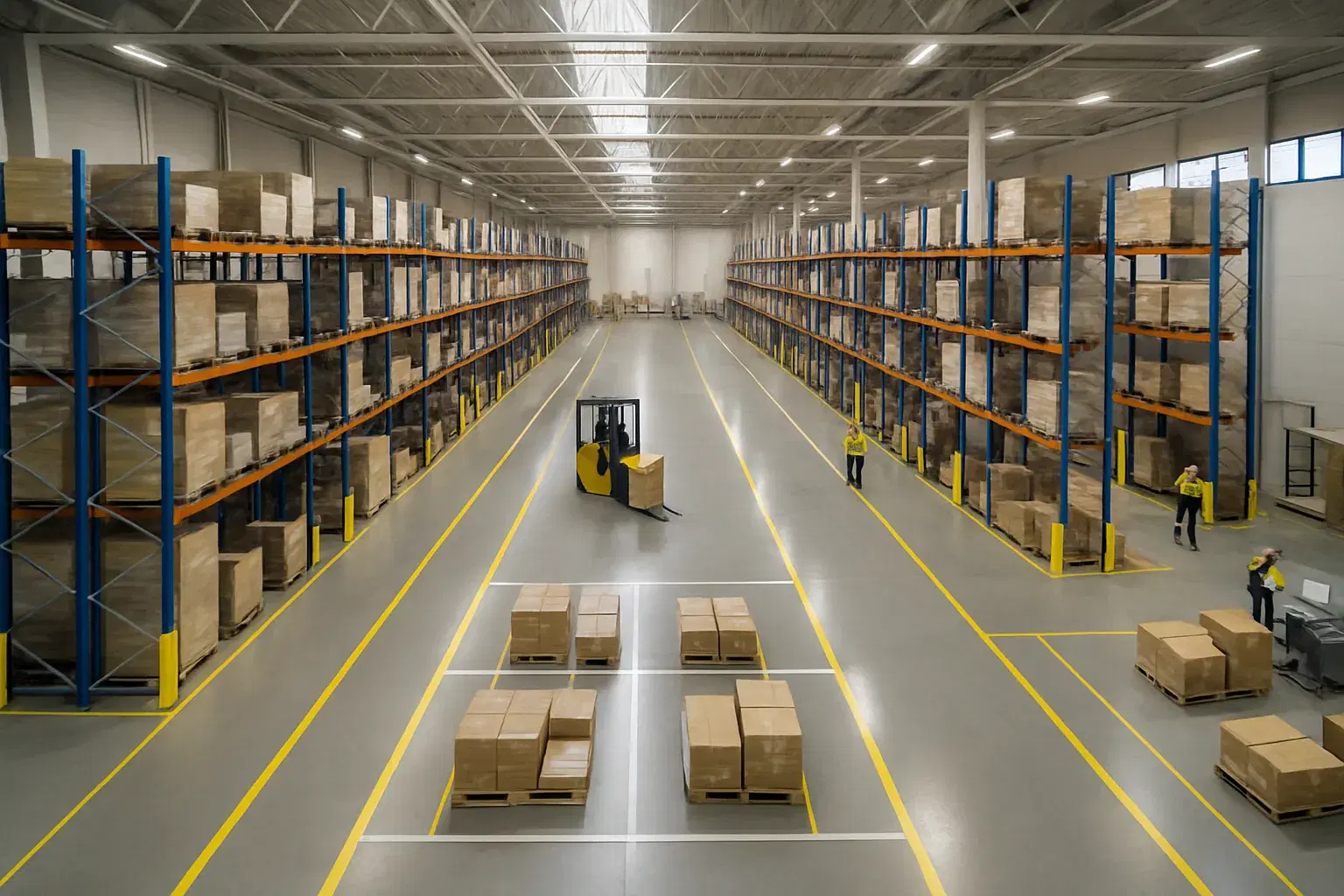
How we count a warehouse
Every engagement runs the same four-stage method, scaled to the site. The discipline lives in the planning and the reconciliation; the counting itself is the part everyone sees, but it is the part that goes right only when the other three are done properly.
1. Planning & cut-off design
We start from the WMS location master and the SKU master, not the floor. The team agrees the count basis (full-site, zoned or cycle), the freeze point for book stock, and how goods-in and goods-out during the count window will be quarantined and treated as cut-off items. We map the building — pick faces, reserve, bulk floor, mezzanine, hazardous and bonded areas, returns, quarantine and damages — and sequence zones so high-rotation pick faces clear first and operations resume behind the count. Count instructions, unit-of-measure rules per SKU class, and the recount threshold are documented before anyone picks up a scanner.
2. Fieldwork & blind recounts
Our own trained counters work the floor — not subcontracted day labour — capturing quantity by location with mobile terminals. Counts are blind: the counter does not see the system balance, so there is no anchoring to the expected number. Any location whose first count falls outside the agreed tolerance is recounted by a second counter before the variance is accepted. Cut-off movements are logged live. Throughout, the supervisor monitors coverage and hit rate so that no location is missed and no aisle is double-counted.
3. Reconciliation & cause-coding
Counted quantities are matched to the WMS line by line. Pure location errors — right SKU, right total, wrong bin — are identified and corrected in the system on the spot, so the operation gets the pick-rate benefit immediately. Remaining differences are cause-coded (receiving, mis-pick, UoM, damage, unrecorded return, genuine loss) and the net and gross variance are reported separately. Nothing is posted as shrinkage until the explicable categories have been removed.
4. Reporting & sign-off
The deliverable is a posting-ready adjustment file in the structure your ERP expects, plus an exception report, the KPI pack (item accuracy, location accuracy, net and gross variance, shrinkage rate) and the cut-off documentation an auditor will ask for. For 3PL counts the report is addressed to both the operator and the stock owner. Where the count is part of a lender-driven or year-end requirement, an independent stock audit opinion accompanies the data.
Count types we run
Different objectives call for different count designs. Most distribution operations end up using a combination — an annual wall-to-wall for the auditor, a cycle programme for control, and ad-hoc client or bonded counts as contracts and regimes require.
| Count type | What it is | When it fits |
|---|---|---|
| Wall-to-wall annual count | Full-site, every location, frozen book stock | Year-end existence and valuation; auditor attendance under ISA (UK) 501; Companies Act s.386 statement of stocktakings |
| Zoned / phased count | Site split into zones counted in sequence behind a moving freeze | Large DCs that cannot fully stop; resume picking zone by zone |
| Cycle counting (ABC) | High-velocity and high-value bins counted on a rolling schedule | Perpetual accuracy without an annual shutdown; early variance detection |
| 3PL client stock audit | Independent count of one client’s owned stock | Custody evidence for the 3PL; existence evidence for the client’s accounts |
| Bonded / customs count | Duty-status population counted as a discrete schedule | HMRC warehouse record obligations; duty exposure on variances |
| Mobilisation / de-mobilisation count | Baseline at contract start or hand-back | Clean opening or closing position when a 3PL contract begins or ends |
3PL and shared-user warehousing
Third-party logistics changes who needs the number and why. The stock belongs to the client; the building, the labour and the WMS belong to the 3PL; and the contract between them sets out who carries the risk of loss. An independent count is the only instrument that serves both parties at once.
- For the 3PL, a clean independent count is evidence of custody performance and a defence against client claims. It also protects the operator at contract boundaries — a verified opening balance at mobilisation and a verified closing balance at hand-back stop a departing client from charging historic losses to the operator.
- For the stock owner, it is existence evidence for the balance sheet that the company did not produce itself — precisely what auditors prefer when inventory is held at a location the entity does not control. It also surfaces ageing, obsolescence and over-receipts the client cannot see from its own system.
- For shared-user sites, where several clients’ stock occupies the same racking, we count each client’s SKU population discretely and report per owner, so commingling does not blur whose stock is whose.
We run these counts on the client’s SKU master and the contractual count rules, with a report addressed to both sides — so a single mobilisation can settle a service-level dispute and the client’s year-end existence assertion together.
The metrics that matter
A warehouse count produces more than a single variance figure. The metrics below are what we report and what a distribution operation should be managed against — the value variance is what finance posts, but location accuracy is what determines whether the building actually works.
| Metric | How it is measured | What it tells you |
|---|---|---|
| Item accuracy (value) | Counted value ÷ book value, by SKU | The balance-sheet number; what the auditor tests |
| Location accuracy (IRA) | Locations correct ÷ locations counted | The operational number; drives pick rates and short-ships |
| Net variance | Counted total − book total | Headline gain/loss to post to the ledger |
| Gross (absolute) variance | Sum of |line differences| | True disorder — offsetting errors that net to nothing still cost picks |
| Shrinkage rate | Unexplained loss ÷ throughput | Trend metric for loss; escalation trigger |
| Hit rate / coverage | Lines or locations counted ÷ in scope | Completeness of the count itself |
The relationship between net and gross variance is the one most operations miss. A site can post a net variance of nearly zero — losses in one SKU offset by gains in another — while its gross variance is large, meaning the building is full of compensating errors that each cost a pick or a short-ship. Reporting only the net figure makes a disordered warehouse look controlled. We always report both.
From annual count to perpetual accuracy
The annual wall-to-wall count satisfies the record-keeping baseline — Companies Act 2006 s.386(4) statements of stocktakings, and a count your auditor can attend under ISA (UK) 501 — but it is a poor control for a building that turns its stock dozens of times a year. By the time the annual count finds a problem, the stock has been wrong for months and the cause is cold. The operational answer is a cycle counting programme: locations classified by velocity and value (ABC), high-velocity and high-value bins counted on a rolling schedule so every important location is verified several times a year, variances investigated while the cause is still fresh through a disciplined stock reconciliation process, and persistent loss patterns escalated into shrinkage control investigations. A mature cycle programme can hold a distribution centre at perpetual high accuracy and remove the annual shutdown altogether — auditors will accept a well-controlled, well-evidenced cycle count in place of a wall-to-wall freeze.
Where the operation justifies it, RFID on totes, pallets, cages and returnable transit equipment makes counting near-continuous: fixed readers at dock doors and aisle entries register movement automatically, and a handheld UHF reader counts a bay in seconds rather than scanning each label. RFID does not replace the disciplined count — it changes its economics, making frequent verification cheap enough to be routine.
The warehouse is also a fixed asset estate
Stock is only half of what sits in a distribution centre. The building is filled with capital equipment that belongs on the fixed asset register and almost never matches it: racking and mezzanine floors, MHE and forklift fleets, conveyor and sortation systems, automation, dock levellers and shutters, battery and charging plant, and the scanning and IT fleet. Because much of it is mobile — forklifts transferred between sites, equipment hired in and out — the register drifts exactly the way stock does, and ghost assets accumulate.
While the team is mobilised for the stock count we verify and tag that estate and reconcile it to the register, so a single visit settles both the stock ledger and the asset register. The methodology is the dedicated fixed asset verification service, with durable labelling handled under asset tagging; the financial outputs feed a compliant fixed asset register under FRS 102 and support the capital allowances position on plant and machinery — racking, MHE and automation are frequently under-claimed because the asset detail was never captured.
Bonded, hazardous and regulated stock
Some populations carry obligations beyond ordinary accounting records, and they need to be counted as discrete schedules rather than blended into the main reconciliation.
- Customs and excise warehousing. Stock held under a customs warehouse or excise authorisation carries record-keeping duties to HMRC, and any variance has a duty consequence. We count the bonded population separately with duty status per line, so the reconciliation supports both the financial records and the returns filed against the authorisation.
- Hazardous and dangerous goods. ADR and COMAH storage is counted to the method statement and access rules of the site, with the team briefed and inducted before entry — quantity accuracy here is a safety and compliance matter as well as a financial one.
- High-value and serial-controlled goods. Electronics, pharmaceuticals and similar are counted to serial or batch level where the system holds it, giving traceability as well as quantity and supporting recall and expiry control.
Audit, lender and compliance requirements
A warehouse count often has to satisfy more than the operation itself. Under the Companies Act 2006 s.386(4), companies dealing in goods must keep statements of stocktakings sufficient to allow stock at the year end to be determined with reasonable accuracy — a record a wall-to-wall or well-evidenced cycle count produces directly. Where the company is audited, the statutory auditor is expected under ISA (UK) 501 to attend the physical inventory count and obtain evidence over existence and condition; a professionally planned, documented count gives them evidence they can rely on and observe rather than a scramble they have to qualify. The stock figure also flows into FRS 102 inventory measurement — lower of cost and estimated selling price less costs to complete and sell — so the count has to support not just quantity but the obsolescence and net-realisable-value judgements behind the carrying value.
Lender-driven counts add another audience. Where stock is financed — asset-based lending, borrowing-base facilities, inventory financing — the funder needs independent assurance that the eligible stock actually exists at the stated value, and that is precisely what an independent stock audit provides: a third-party count and reconciliation neither the borrower nor the lender produced. For 3PL-held stock the same independence settles the question of whose figure to trust when the goods sit in a building the owner does not control. In every case the deliverable is built to be tested — counted quantity tied to location and SKU, variances cause-coded, cut-off documented — because a count that cannot be audited is not worth commissioning.
Counting around the WMS, not against it
A modern distribution centre is run by its warehouse management system, and a count that ignores that system creates more problems than it solves. The WMS holds the location master, the SKU master, the unit-of-measure hierarchy and the live book balance by bin; the count has to be designed to map onto all of it. We take the location and SKU master as the count framework, so every count record ties to a real bin and a real SKU rather than to a hand-written sheet, and we agree how the system’s unit-of-measure structure — eaches, inners, cases, pallets, catch-weight — will be captured so that a conversion error is not introduced at the point of counting.
The freeze is handled inside the system’s own logic wherever possible. Rather than physically halting the building, we agree a book cut-off, suspend the affected locations from put-away and replenishment, and let the WMS quarantine in-flight tasks. Goods received and despatched during the count window are captured as cut-off items and reconciled explicitly, so a pallet that arrives mid-count is not double-counted or missed. When the reconciliation is complete, location corrections are applied through the WMS adjustment functions with a full audit trail, and genuine variances are exported for posting to the ERP. We routinely work alongside Manhattan, Blue Yonder/JDA, Körber, SAP EWM, Microsoft Dynamics, NetSuite, Mintsoft, Peoplevox and bespoke systems; the principle is the same regardless of the platform.
RFID, barcode and the economics of counting
How a warehouse is counted is a question of economics as much as accuracy. Barcode scanning is reliable and cheap to deploy, but it is line-of-sight and one-at-a-time: a counter has to find, orient and scan every label, which sets a hard floor on how fast a bay can be counted and therefore on how often counting is affordable. UHF RFID removes that floor. A handheld reader captures every tagged tote, pallet or carton in a bay in a single sweep without line of sight, and fixed portal readers at dock doors and aisle entries register movement automatically as stock flows through the building. The effect is not a marginal speed gain; it is a change in what is possible — counting frequently enough that the record never has time to drift.
RFID earns its place fastest on returnable transit equipment and unit-load devices — totes, trays, cages, roll-cages, kegs and pallets — where the assets are reused, valuable in aggregate, and constantly on the move between sites and customers. Tagging that pool turns a perennial shrinkage and balancing problem into a tracked, auto-counted asset class. For the stock itself, the decision is driven by volume, value density and how often the operation genuinely needs to know. Because CPCON is not a software vendor, we recommend the level of automation the operation justifies — many sites are served perfectly well by durable barcode tagging applied during a verification, and we say so when that is the right answer.
Cycle counting designed for a working warehouse
A wall-to-wall count is a snapshot; a cycle counting programme is a control. The difference matters most in a building that turns its stock dozens of times a year, where a problem found at the annual count has been live for months and its cause has long gone cold. A well-designed cycle programme classifies locations by an ABC-style combination of pick velocity and value, then counts the critical bins on a rolling schedule so every important location is verified several times a year and the long tail at least annually. High-velocity pick faces, high-value SKUs, and any bin that has thrown a recent variance are counted most often.
The discipline that makes cycle counting work is what happens after the count, not the count itself. Each variance is investigated while the trail is fresh — the receipt, the pick, the put-away that caused it can still be traced — and cause-coded so the operation fixes the process, not just the number. Over time the variance data points to the genuine problem areas: a slot that is chronically mis-located, a SKU with a unit-of-measure trap, a shift pattern that correlates with loss. A mature, well-evidenced cycle programme can hold a distribution centre at perpetual high accuracy and, crucially, satisfy an auditor in place of an annual wall-to-wall freeze — the count is continuous, documented and testable, which is exactly what ISA (UK) 501 evidence should be.
E-commerce, omnichannel and returns
Fulfilment operations stress stock accuracy harder than almost any other model. Single-unit picking multiplies the number of touches per order; forward-pick and bulk-reserve layouts mean the same SKU lives in several places at once; and the returns flow re-injects stock that has to be inspected, graded and put away cleanly before it can be promised again. An oversell caused by a phantom unit is not just a stock variance — it is a cancelled order and a lost customer. We count forward-pick and reserve as a reconciled whole rather than two disconnected populations, track location accuracy at the pick face specifically because that is where oversells originate, and pay particular attention to the returns and grading area, where stock most often goes adrift. For omnichannel operations that fulfil store and online demand from the same building, the count separates and reconciles the channels so neither hides the other’s errors.
Cold chain, perishable and date-controlled stock
Temperature-controlled and perishable operations add constraints that shape how a count is run. Time in a chilled or frozen environment is limited for the team and must not compromise the stock, so chambers are counted in planned, time-boxed passes with the right protective equipment and induction. Date and batch control is integral rather than incidental: we capture expiry and batch where the system holds it, so the reconciliation also surfaces stock approaching end of life and supports rotation, recall and waste control. For perishable goods the variance story is often as much about shelf-life write-off discipline as about loss — stock pulled from the pick face for date reasons but never adjusted out of the system is a common and correctable source of phantom inventory.
Where we work
The same method applies across the breadth of UK logistics: national and regional distribution centres, e-commerce and omnichannel fulfilment, 3PL and 4PL shared-user and dedicated sites, cold and ambient storage, port and airport handling facilities, bonded and customs warehouses, parts and spares depots, and bulk and palletised wholesale. Estates have ranged from a single 50,000-square-foot unit to multi-site networks counted as one programme and reported as one dataset. For year-end and lender-driven counts — inventory financing, client audits of 3PL-held stock — our independent stock audit service provides the third-party evidence the situation demands, and the full counting service is described under stocktaking services. To plan a programme around your operation, get in touch via the contact page.
Frequently asked questions
Do we have to stop despatch for the count?
Rarely for long. Counts are planned around despatch cut-offs: book stock is frozen at an agreed point, goods-in and goods-out during the count window are logged and reconciled as cut-off items, and high-rotation pick faces are counted first so operations resume zone by zone. A full-site freeze is usually only needed for a few hours, if at all — and on operations that genuinely cannot stop, a rolling cycle count programme removes the freeze entirely.
We are a 3PL. Can you count one client’s stock independently?
Yes — and independence is exactly the point. Client-owned stock counted by a third party gives both sides a number neither produced: the 3PL demonstrates custody performance, the client gets existence evidence for its own accounts and auditors. We run these as discrete counts with the client’s SKU master, contractual count rules and a report addressed to both parties, so a single visit can settle a service-level dispute and satisfy the client’s year-end at the same time.
How accurate should a warehouse be at bin level?
Well-run operations target high item-level accuracy with bin-level (location) accuracy tracked separately — a unit in the wrong bin is invisible to picking even though the site total is right. Our counts report both figures, because the gap between them is the operational story: location accuracy drives pick rates and short-ships, item accuracy drives the balance sheet. Inventory Record Accuracy (IRA) measured by location is the metric a distribution centre should be managed against, not the headline value variance.
Can you handle bonded and customs warehouse stock?
Yes. Stock held under customs or excise regimes carries record-keeping obligations to HMRC on top of normal accounting records, and duty exposure makes variances expensive. We count bonded populations separately with the duty status recorded per line, so the reconciliation supports both your financial records and the returns your customs team files against the warehouse authorisation.
How do you count an automated or high-bay warehouse you cannot walk?
Automated storage — ASRS, mini-load, high-bay cranes, shuttle systems — is counted through the WMS and the automation host rather than by climbing the racking. We agree a method statement with the operator: cycle the cranes to present locations, count at the induction or pick station, or reconcile the host inventory against the WMS and sample-validate. Manual reserve, pick modules and bulk floor stock are counted physically and tied back to the same reconciliation.
Will the results reconcile to our WMS and ERP?
Yes. We export counted quantities by location and SKU in the structure your systems expect — Manhattan, Blue Yonder/JDA, Körber, SAP EWM, Microsoft Dynamics, NetSuite, Mintsoft, Peoplevox and others — classified as matched, location-error, found-not-on-system or system-not-found. Location corrections are applied during the count; genuine variances are posted to the ERP with cut-off documentation attached, so finance can book a clean adjustment.
Can you also verify our racking, forklifts and warehouse fixed assets?
Yes, and it is efficient to do both in one mobilisation. While the team is on site for the stock count we verify and tag the fixed asset estate — racking and mezzanines, MHE and forklifts, conveyor and sortation, dock equipment, battery plant and the IT/scanning fleet — and reconcile it to your fixed asset register. One visit settles both the stock ledger and the asset register.
Plan a warehouse count around your operation
Tell us about your sites and asset volumes — we respond within one business day with a scoped proposal.
Request a Proposal