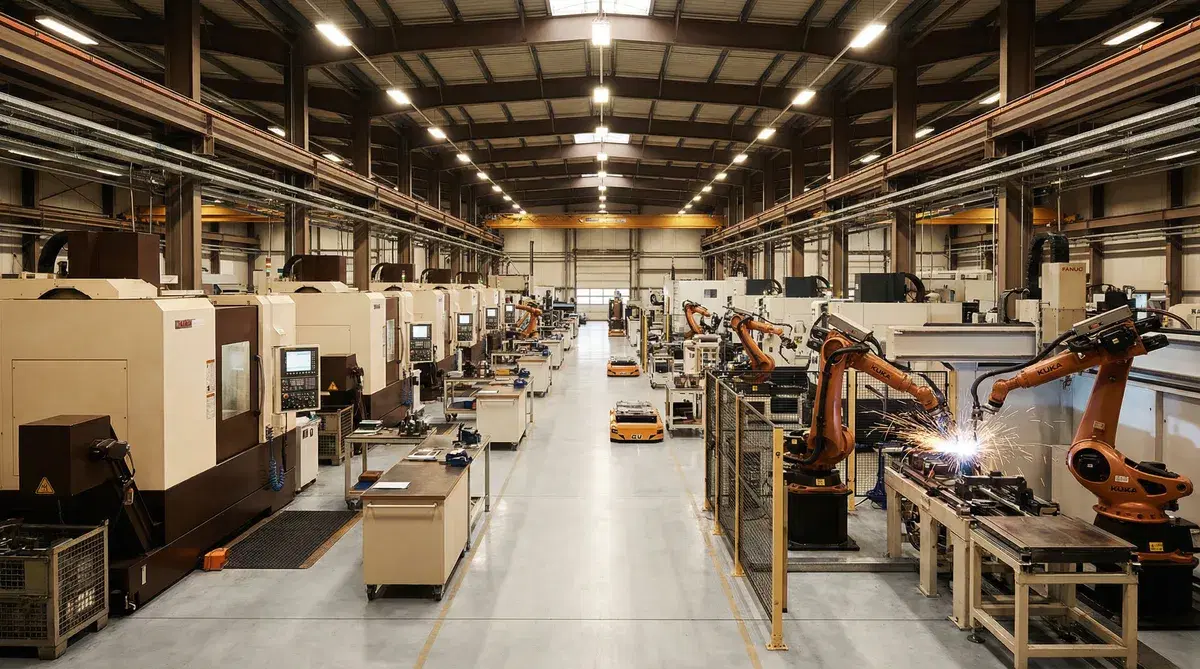
Asset verification for manufacturing plants
Plant & machinery, tooling, moulds and WIP — verified on the shop floor, reconciled to the register and the maintenance system, and documented to the standard your auditor and HMRC expect.
No sector strains a fixed asset register like manufacturing. Lines are rebuilt, machines are moved, cannibalised for spares or quietly scrapped; tooling migrates to supplier sites; capex projects sit in assets-under-construction long after commissioning. After a few years the register and the shop floor describe two different factories — and depreciation, insurance values and capital allowances are all being calculated on the wrong one. The cost is not abstract: an over-stated balance sheet inflates insurance premiums every renewal, ghost plant keeps depreciating against the P&L, and the year-end physical-existence test becomes a fire drill instead of a formality.
CPCON’s manufacturing practice exists to close that gap. Our own field teams — not subcontractors — walk the plant, physically verify and tag every asset in scope, and reconcile what they find against three records at once: the fixed asset register finance depreciates, the CMMS or maintenance system engineering works from, and where relevant the production layout itself. That physical-versus-logical reconciliation is what turns a walkround into evidence. Across 30+ years and more than 4,500 verification and inventory projects, asset-intensive industry has been the core of what we do — read more about our experience or start with the underlying fixed asset verification service this practice is built on.
Why manufacturing registers drift faster than any other sector
A manufacturing estate is the worst possible environment for a static register because the assets are the business and the business never stops changing them. Every line change, every efficiency project, every preventive-maintenance rebuild touches the asset base — and almost none of those events generate a clean entry in the fixed asset register. The failure modes are predictable enough that we plan the engagement around them:
| What happens on the floor | What the register shows | Consequence if left |
|---|---|---|
| Machine scrapped or sold during a line change | Asset still capitalised and depreciating | Ghost asset; over-stated NBV; over-stated insurance; over-claimed allowances |
| New machine bought locally and commissioned | No corresponding addition | Uncapitalised asset; under-insured; missed capital allowances |
| Line rebuilt; drive and controls replaced, frame kept | One blended line asset, single depreciation rate | FRS 102 component accounting not supported; misstated depreciation |
| Machine moved between sites or cells | Location field stale or blank | Year-end existence test fails; assets unlocatable on sampling |
| Capex project commissioned and running | Still sitting in assets under construction | Depreciation not started; AUC balance unreconciled to real assets |
| Tooling sent to a sub-contractor | No off-site location; ownership unclear | Owned tooling lost; customer-funded tooling wrongly on balance sheet |
Each row in that table is a different reconciliation outcome, and each needs a different correcting entry. A generic count that only says “found / not found” cannot tell them apart — which is why our reconciliation classifies every line, and why the output is a set of posting-ready schedules rather than a raw asset list.
What we verify on a manufacturing site
Plant & machinery
Production lines, CNC machines, presses, robots, conveyors and ancillary plant — identified by plate, serial and location, with componentised assets mapped parent-to-child.
Tooling, jigs, dies & moulds
Controlled tooling registers including items at supplier premises, with customer-funded tooling flagged separately from your own and condition graded for replacement planning.
Assets under construction
Capex projects reviewed at commissioning so AUC balances are capitalised to real, locatable assets — not left as an unreconciled lump that delays the start of depreciation.
Raw materials & WIP stocktakes
Stock counts designed around production cut-offs, with stage-of-completion conventions agreed with finance before counting starts and variances analysed, not averaged.
Plant & machinery: the discrete, high-value core
Fixed plant is where the value concentrates and where mis-statement hurts most. We identify each machine by manufacturer’s plate, serial number and physical location, photograph it for the evidence file, and grade its condition so finance can see candidates for impairment review and engineering can see candidates for replacement. Where a single capitalised entry actually covers a cell of several machines — a common shortcut in older registers — we break it back out into the assets that physically exist, because an entry that bundles five machines into one line cannot survive a sampling auditor who asks to see “asset 10473” and is shown a whole bay.
Tooling, jigs, dies and moulds: the population everyone loses
Tooling is the single most mismanaged asset class in manufacturing. It is high in volume, low in unit value (so often below the capitalisation threshold and therefore off the main register entirely), highly mobile, and frequently resident at a supplier’s premises rather than your own. The two questions that matter are where is it and who owns it, and a controlled tooling register answers both. We record tools at third-party sites as off-site but owned, and we flag customer-funded tooling — tools a customer paid for, sitting on your floor, that are not your asset — separately, so the day a contract ends or a customer audits their property, the answer already exists. The same register feeds replacement budgeting: a die graded as near end-of-life is a capex line you can plan rather than a line-stopping surprise.
Assets under construction: capitalise what is actually running
On capex-active sites the assets-under-construction balance is often the least scrutinised number on the balance sheet. Projects are commissioned and producing for months before the AUC entry is broken out into real, depreciable assets — which means depreciation starts late, the AUC balance is unreconciled to anything you can point at, and the capital allowances clock has not started either. We review AUC at commissioning, attach the balance to the specific assets now operating on the floor, and hand finance the breakdown needed to start depreciation and the allowance trail on time.
Built around UK reporting and tax
Manufacturing asset data does not exist for its own sake — it feeds the financial statements and the tax computation, and both have specific UK requirements that bite hardest in this sector.
FRS 102 Section 17 and component depreciation
Under FRS 102 Section 17, where significant components of an item of property, plant and equipment have materially different useful lives or patterns of consumption, those components must be depreciated separately. That rule was written for exactly the kind of asset manufacturing is full of: a press line whose frame might last twenty years, whose hydraulics last ten and whose PLC and drives last five. Depreciate the whole line on one rate and the early years are understated and the later years overstated. We capture the parent/component structure in the field — frame, drive system, control unit, safety guarding — so the register can actually carry component lives instead of approximating them. The same standard’s Periodic Review amendments, effective for accounting periods beginning on or after 1 January 2026, also bring leased plant on-balance-sheet, adding a population of right-of-use machinery that has to sit alongside owned plant in the register and be verified to the same standard.
Capital allowances on plant and machinery
The tax side is just as physical. Capital allowances are claimed asset by asset, and an HMRC enquiry is answered with asset-level records: what was bought, where it is, that it exists and that it is in use. Manufacturing is allowance-rich precisely because it is plant-heavy, but the pools have to be allocated correctly. The headline reliefs are worth getting right:
| Relief | Applies to | Why verified records matter |
|---|---|---|
| Full expensing / first-year allowances | Qualifying new main-rate plant and machinery for companies | Each qualifying asset must be identifiable and demonstrably in use |
| Annual Investment Allowance (AIA) | Most plant and machinery up to the annual limit | Allocation across assets has to be evidenced and not duplicated |
| Main-rate writing down allowances | General plant and machinery pool | Disposals must leave the pool — ghost plant overstates the pool |
| Special-rate writing down allowances | Integral features and long-life assets | Integral features must be separated from main-rate plant |
Classification into pools is your tax adviser’s decision; what CPCON supplies is the verified asset-level record that makes the classification possible and defensible. Disposal cleanup is the other half: scrapped machines still sitting in the pool overstate both the balance sheet and the allowances claimed against them, and our reconciliation surfaces them with the verification date and photograph that evidences when they actually left.
Records, insurance and accounting law
Beyond the standards, the Companies Act 2006 s.386 duty to keep accounting records that disclose the company’s assets with reasonable accuracy at any time means a register that has drifted is not just an audit nuisance — it is a records failure. And because reinstatement insurance is priced on declared values, a register carrying ghost plant means you are paying premium on machinery that no longer exists while potentially under-declaring the machinery that does. At year end, auditors testing physical existence under ISA (UK) 501 will sample the register and ask to be shown the asset; a verified, tagged, photographed baseline turns that test from an anxious hunt into a confirmation, and it is exactly the evidence an audit team wants to see prepared in advance.
The shop floor is a hostile environment for asset data
What makes manufacturing verification a specialist job is not the counting — it is the environment. Heat, coolant, swarf, vibration, wash-down chemicals and constant movement destroy ordinary labels and defeat naïve tagging, and a tag that falls off in six months leaves you exactly where you started. Matching the identification material to the zone is half the engagement, and our field teams specify it asset by asset rather than applying one label type across the site.
| Environment | What destroys ordinary tags | Identification we specify |
|---|---|---|
| Foundries, furnaces, heat-treatment | High temperatures melt adhesives and print | Etched or engraved metal plates, riveted or bonded |
| Machine shops, CNC, presses | Coolant, oil and swarf lift and abrade labels | Anodised aluminium or industrial polyester, on-metal RFID |
| Food, drink & pharma wash-down | Aggressive cleaning chemicals and high-pressure water | Sealed, chemical-resistant labels rated for the regime |
| Cold stores & chilled lines | Low temperatures and condensation defeat adhesives | Low-temperature-rated tags applied to prepared surfaces |
| Mobile tooling & small assets | Handling, transit to suppliers, loss | Hard-wearing tags or on-metal RFID for automated counting |
The other half is access and safety. A manufacturing site is a working, hazardous environment, and verification has to respect that absolutely. Our teams complete site inductions, work to your PPE and competency requirements, observe lockout/tagout and permit-to-work interfaces, keep clear of moving plant and automated cells, and never isolate, open or operate machinery to read a plate. Where a plate can only be reached safely with the machine stopped, that asset is scheduled into a planned maintenance window or shutdown rather than forcing an unsafe approach. The full detail of how we apply identification in these conditions is set out on the asset tagging service page.
What a clean manufacturing register actually looks like
“Accurate” is too vague to deliver against, so we work to a concrete data standard. A register that has been through CPCON verification carries, for every asset in scope, a defined set of attributes that make it usable for finance, tax, engineering and audit at once:
- A unique asset tag number physically present on the asset and matching the record.
- A clear description and asset class that maps to your chart of accounts and your capital allowances pools.
- Manufacturer, model and serial number captured from the plate, so safety notices and warranty claims can be traced.
- A verified location down to building, area and cell — not a stale cost-centre code.
- A condition grade that flags impairment candidates for finance and replacement candidates for engineering.
- A parent/component structure where the asset is a line or cell with separately depreciable parts.
- Ownership and funding status, including customer-funded tooling and off-site assets at suppliers.
- A dated photograph in the evidence file, time-stamping existence on the verification date.
That attribute set is the difference between a list and an asset management baseline. It is what lets the same data answer an HMRC enquiry, support an insurance or financial valuation, survive an auditor’s sample, and drive an engineering replacement plan — without anyone re-surveying the plant to produce each one separately.
The cost of leaving the register to drift
The case for verification is rarely about tidiness; it is about money leaking quietly in four directions at once. A drifted manufacturing register over-states depreciation on ghost plant, so the P&L carries a charge against machines that no longer exist. It over-states reinstatement values, so insurance premiums are paid every year on assets that are gone — while the assets that were bought locally and never capitalised may be under-insured. It over-states the capital allowances pools, exposing the tax computation to adjustment in an enquiry. And it costs engineering and finance real time at every year end, every insurance renewal and every refinancing, because the underlying data cannot be trusted and has to be reconstructed under deadline. Verification stops all four leaks from the same baseline — which is why the business case usually pays for itself before the second annual count.
How an engagement runs
- Planning with production and HSE. Access windows, induction and PPE requirements, zones that need shutdown access, lockout/tagout interfaces and the register extract agreed in advance, so the team is productive from hour one and never in the way of a running line.
- Floor verification and tagging. Every asset in scope physically confirmed and tagged with materials matched to the environment — anodised or etched metal plates for heat, coolant and abrasion, on-metal RFID where automated counting is the goal, barcodes where line-of-sight is fine.
- Three-way reconciliation. Field data matched to the fixed asset register and the maintenance system; ghost assets, unrecorded additions, transfers and component splits documented with posting-ready schedules.
- Reporting and sign-off. Exception schedules, component structures, a write-off pack for finance sign-off, the capital allowances evidence trail, and a clean register handed back in your system’s structure (SAP, Oracle, Sage, Microsoft Dynamics or other).
The reconciliation is the heart of it, so it is worth being precise about the outcomes. Every line of the register and every asset found on the floor is classified into one of four states, and each state carries its own correcting action:
| Reconciliation outcome | Meaning | Finance action |
|---|---|---|
| Matched | On the register and verified on the floor | Confirm attributes; update location and condition |
| Found, not on register | Physical asset with no register entry | Capitalise; assess missed allowances and insurance |
| On register, not found (ghost) | Register entry with no physical asset | Write off; remove from pool; correct insured values |
| Transferred | Exists, but at a different site or cell | Correct location; reassign cost centre |
Multi-site programmes and ERP integration
Most manufacturers do not run one plant — they run an estate, often on a shared ERP with inconsistent local practice. We deliver multi-site verification as a programme rather than a series of unconnected visits: a common method statement, a common data standard and a common reconciliation logic applied site by site, in waves, so each plant benefits from what the previous one taught us. That consistency is what makes the consolidated register trustworthy at group level, instead of a federation of registers that were each “cleaned” to a different definition.
The reconciled data is delivered mapped to your finance system’s structure — SAP, Oracle, Sage, Microsoft Dynamics and others — and to your chart of accounts and capital allowances pools, so the result is posting-ready rather than a spreadsheet your team has to re-key. Where the maintenance world runs on a separate EAM or CMMS (SAP PM, IBM Maximo, Infor EAM, Fiix), the same field dataset feeds both, which is how a single survey reconciles finance and engineering in one pass instead of two. The detail of how we structure and hand back the register sits on the fixed asset register service page.
RFID on the shop floor: from annual count to continuous accuracy
A verified register is a snapshot; manufacturing changes the moment you put the clipboard down. For estates that want to stop the drift rather than just correct it periodically, on-metal RFID asset tracking turns the annual plant survey into a routine scan. Industrial RFID tags are built for the environment — specified to survive heat, coolant, vibration and wash-down, and engineered as on-metal labels so they read reliably when fixed directly to machinery, which ordinary tags cannot do. A handheld reader walked down a bay captures dozens of assets in seconds; fixed readers at line entries and goods-out can flag when a high-value tool or mobile asset moves. The economics are simple: the survey cost is paid once, and every subsequent count collapses from a multi-week re-survey to a scan a site team can run themselves.
Between full counts, a cycle counting programme keeps raw material and component stores accurate without ever stopping the line for a wall-to-wall stock count, and where finished goods and WIP need independent assurance our stocktaking services and independent stock audit cover that side of the balance sheet to the same evidence standard.
Asset-intensive sub-sectors we work across
“Manufacturing” covers very different physical environments, and the count design changes with each. The methodology is constant; the access plan, tagging materials and asset classes are not.
- Automotive and component supply. High tooling volumes, large amounts of customer-funded tooling, press shops and paint lines, and tight just-in-time stock that makes cut-off discipline critical.
- Food, drink and FMCG. Wash-down environments and hygiene zones demanding sealed, chemical-resistant tags; fast line changes; and significant ancillary plant (refrigeration, utilities, packaging) that registers routinely under-record.
- Pharmaceutical and chemical. Validated equipment, cleanroom access controls, and a strong overlap with calibration and maintenance records that the verification has to respect rather than disturb.
- Metals, plastics and heavy fabrication. Furnaces, presses and machine tools where heat and abrasion destroy ordinary labels, making etched-metal and on-metal RFID the only durable identification options.
- Aerospace and precision engineering. High-value, long-life machine tools, extensive calibrated tooling, and traceability expectations that reward a clean, photographed, serial-level register.
- Electronics and assembly. Large fleets of small, mobile, high-value test and assembly equipment — exactly the profile where RFID and a technology-asset inventory approach pay off.
What a typical plant verification finds
Although every site is different, the pattern of findings on a plant that has not been physically verified for several years is remarkably consistent. Registers that have been left to drift routinely show ghost-asset rates in the 10–30% range — machines scrapped, sold or cannibalised that are still depreciating — while at the same time carrying unrecorded additions where local capex never reached the register. The componentisation is usually missing entirely: long production lines sit as single blended assets that cannot support the separate depreciation FRS 102 expects. Locations are stale, so the year-end existence test would fail on sampling. And the tooling population is frequently invisible: thousands of pounds of owned tools at supplier sites with no off-site record, mixed in with customer-funded tooling wrongly sitting on the balance sheet. None of this is unusual — it is simply what happens when an asset-intensive business changes faster than its records, and it is exactly what the engagement is designed to surface and correct.
The corrections flow straight into decisions finance and engineering were already trying to make: ghost plant comes out of the pool and off the insured schedule, reducing both the tax exposure and the premium; uncapitalised assets go on, recovering missed allowances and closing an under-insurance gap; component structures let depreciation be re-based correctly; and a clean, located, condition-graded register hands the engineering team a replacement plan it can cost. That is the difference between a count and a result.
What you receive
The deliverable is built to be used by finance, by engineering and by your auditor without translation:
- A verified, photographed, tagged asset register in your system’s structure.
- Reconciliation schedules classifying every line: matched, found-not-on-register, register-not-found and transferred.
- A ghost-asset write-off pack with estimated balance-sheet and tax impact for finance sign-off.
- Parent/component structures to support FRS 102 Section 17 depreciation.
- A controlled tooling register, including off-site and customer-funded tooling.
- Capital allowances evidence: asset-level records mapped to the invoice trail and split by pool.
- An optional RFID baseline so the next count is a scan, not a re-survey.
Disposals, decommissioning and end-of-life evidence
The end of an asset’s life is where manufacturing registers leak most quietly, because scrapping a machine during a busy line change rarely triggers a disposal entry. The result is a pool full of plant that physically left the site years ago — over-stating the balance sheet, over-stating the insured values and over-claiming allowances against assets that no longer exist. Our reconciliation treats decommissioning as a first-class outcome: every register line with no matching physical asset is reported as a ghost, dated to the verification, and packaged into a write-off schedule your auditors can test. For sites with significant ongoing disposal activity, a verified baseline plus periodic cycle counting keeps the register honest going forward, so the next year end does not start from the same backlog of un-recorded scrappings.
Why an independent verification carries more weight
Many plants attempt an internal asset count at some point, and it almost always under-delivers — not because the people are not capable, but because they are doing it around a day job, to an inconsistent definition, with no dedicated tooling and an understandable reluctance to write off a colleague’s capex. An independent verification removes all four constraints: it is performed by a dedicated field team to a documented, consistent method; it tags and photographs as it goes so the evidence is reusable; and it has no incentive to flatter the numbers, which is precisely what gives the result weight with an auditor, an insurer or HMRC. That independence is the difference between a register your finance team hopes is right and one they can defend. It is also the standard the cpcongroup.com methodology has been refined to across more than 4,500 projects — read more about our experience.
Every UK engagement is delivered by CPCON’s own senior methodology and field teams — the same approach the cpcongroup.com group has run for FTSE-scale and Fortune-500 manufacturers across six countries — not a franchised count crew. If your plant register no longer matches your plant, that gap is exactly what we close. See how the same discipline applies in adjacent sectors such as energy & utilities and logistics & warehousing, or return to the industries overview.
Frequently asked questions
Can you verify plant without stopping production?
Usually, yes. Most plant verification is planned around the production calendar: fixed lines are verified while running (visual identification, plate checks and photography from safe positions), mobile and ancillary equipment between shifts, and anything requiring close access during planned maintenance windows or shutdowns. A full stop is rarely needed — what matters is agreeing the access plan with production and HSE before the team arrives, so the count fits the factory rather than the factory stopping for the count.
How do you deal with tooling, jigs and moulds below the capitalisation threshold?
They are usually the messiest population on site: high volume, mobile, often at supplier premises. We record them in a controlled tooling register separate from the capitalised plant register, with location (including third-party sites), condition and ownership. Customer-funded tooling is flagged separately because it is not your asset even though it is on your floor — and your own tooling sitting at a supplier is recorded as off-site but owned, so it stops being invisible the moment that relationship changes.
What evidence do you produce for capital allowances claims?
Asset-level verification records: a unique tag number, description, serial, location, photograph and verification date for each item of plant, reconciled to the invoice trail in the register. That is the record set that supports full expensing, the Annual Investment Allowance and writing down allowance claims — and the one HMRC asks for in an enquiry. We flag disposals still sitting in pools so claims are not overstated, and we separate main-rate plant from special-rate integral features so the pool allocation can be defended.
How long does a plant verification take?
A single mid-sized plant (2,000–5,000 capitalised assets) typically takes one to two weeks of fieldwork with a small team, plus reconciliation. Multi-site programmes run in waves so each site learns from the previous one. RFID or barcode tagging during the same visit adds little time and makes every future count dramatically faster — the second count is a scan, not a re-survey.
How do you handle componentised plant and parent/child assets?
In the field. When a production line is one capitalised asset but holds sub-assemblies with materially different useful lives — a long-life frame, a mid-life drive system, a short-life control unit — we capture the parent/child structure on site rather than reconstructing it from invoices afterwards. That structure is what lets the register support FRS 102 component depreciation properly instead of depreciating the whole line on a single blended rate.
Can you reconcile our maintenance system (CMMS) as well as the asset register?
Yes, and on asset-intensive sites that three-way reconciliation is the point. Engineering runs the plant from a CMMS or EAM (SAP PM, IBM Maximo, Infor, Fiix and others); finance depreciates from the fixed asset register; the two are almost never aligned. We match field findings to both, so a critical machine that maintenance services every month but finance fully wrote off years ago — or vice versa — is surfaced and corrected, not left as a silent risk to either function.
Do you support raw material, WIP and finished-goods stocktakes too?
Yes. Plant verification and stock counting are different disciplines but they share a site and a finance team, so we frequently run both. Stocktakes are designed around production cut-offs, with stage-of-completion conventions for work in progress agreed with finance before counting starts, and the result feeds the same audit evidence pack as the fixed-asset work.
Scope a plant verification for your sites
Tell us about your sites and asset volumes — we respond within one business day with a scoped proposal.
Request a Proposal