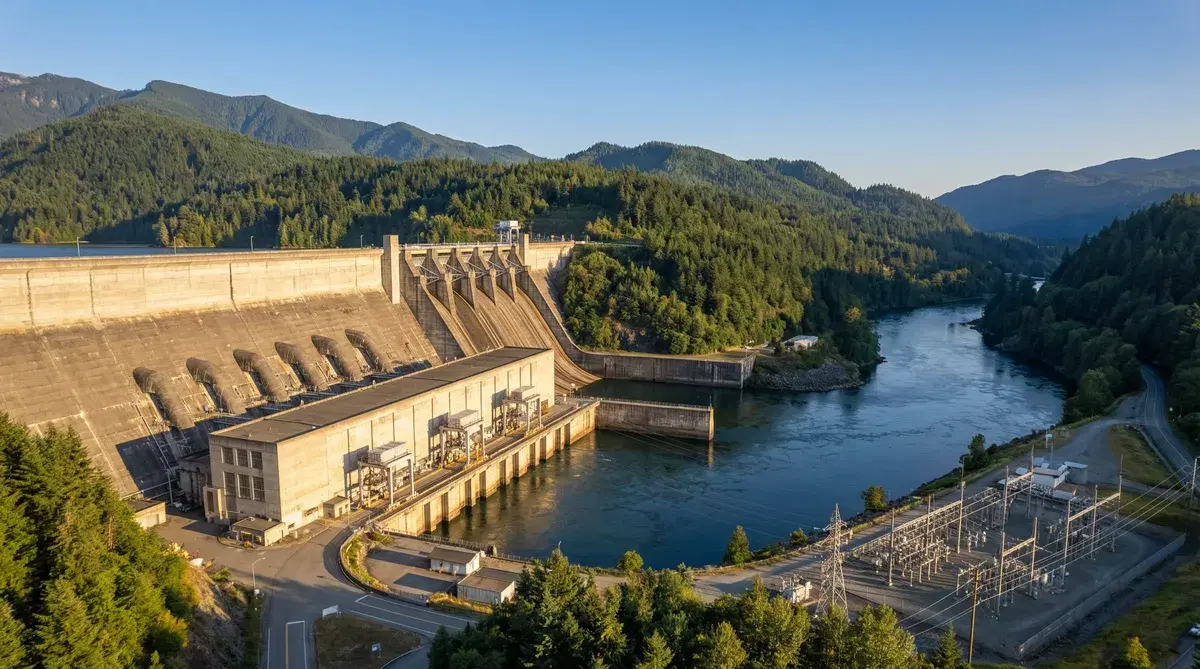
Asset verification for energy & utilities
Generation plant, networks and treatment works — verified in the field, componentised in the register, and documented to the standard regulatory reporting demands.
Energy and utility companies are, in accounting terms, asset registers with operations attached. Generation plant, substations, networks, treatment works and metering fleets dominate the balance sheet, run for decades, and sit behind every regulatory conversation the business has. When the register drifts from the field — assets replaced during maintenance but never re-recorded, components renewed without derecognising the old, capex closed to one undivided line — the error compounds across depreciation, insurance, tax and regulatory reporting simultaneously. In an asset-intensive business, a register error is never confined to one ledger.
CPCON verifies utility estates at field level: our own teams, inducted and permitted under your site rules, physically confirm discrete assets site by site and reconcile network populations against GIS and asset management systems. The output is a register your finance, engineering and regulation teams can all defend — because for price-controlled businesses reporting against a regulated asset base (the RAB-style models used by UK regulators such as Ofgem for electricity and gas networks and Ofwat for water), the asset data layer is not back-office hygiene; it is the substance behind the submission. With more than 30 years of international experience and over 4,500 inventory and asset projects delivered, we bring a method built for dispersed, asset-heavy estates.
Asset populations we cover
Generation & process plant
Turbines, engines, boilers, transformers and balance-of-plant verified by nameplate and location, with parent/component structures captured.
Networks & infrastructure
Substations, pumping stations and treatment works fully verified; linear assets reconciled against GIS and asset management records.
Fleet, tools & operational equipment
Vehicles, mobile plant, instruments and depot stores — the mobile population where registers usually fail first.
Capex & assets under construction
Commissioning-stage verification so AUC balances capitalise to real, componentised assets rather than undifferentiated project lumps.
The regulated asset base is only as real as the register beneath it
Network and water companies in Great Britain are funded through price controls built on a regulated asset base — the RAV in Ofwat’s framework, the RAB in Ofgem’s — and the return a business is allowed to earn is calculated on that value. The figure is enormous, long-lived and cumulative: today’s RAB is the sum of decades of capital additions, depreciation and disposals carried forward. Which means the integrity of the underlying fixed asset register is not an accounting detail; it is the foundation of the regulatory settlement itself.
Price-control submissions and the business plans behind them (Ofgem’s RIIO framework for energy networks, Ofwat’s periodic Price Reviews for water) lean on asset existence, condition, age and componentisation data. When the register holds assets that no longer exist, omits assets that were installed and never recorded, or capitalises renewals without retiring what they replaced, the regulated value drifts from reality and every party that relies on it — finance, the regulator, the external auditor, the cost assessment teams — inherits the error. An independent physical verification gives them a documented field basis to stand on. We supply that verified data layer; the regulatory determination remains, as it must, the regulator’s.
Generation, transmission, distribution — three different verification problems
“Energy and utilities” spans wholly different asset populations, and a credible method treats them differently rather than counting everything the same way.
| Segment | Typical assets | Verification approach | Useful life band |
|---|---|---|---|
| Generation | Turbines, engines, boilers, generators, balance-of-plant | Full physical, nameplate & location, componentised | 15–40 years |
| Transmission | Grid substations, transformers, switchgear, overhead lines | Site assets physical; lines/towers sampled & GIS-reconciled | 30–60 years |
| Distribution | Primary/secondary substations, cables, kiosks, meters | Discrete sites physical; cables records-based; meters by fleet | 20–45 years |
| Water & wastewater | Treatment works, pumping stations, mains, reservoirs | Works fully physical; mains records-based; civils long-life | 15–80+ years |
Discrete site assets get full physical verification — identified, photographed, located and recorded by nameplate. Linear and buried assets, which cannot honestly be eyeballed, are verified through access-point sampling, records review and GIS reconciliation, with the confidence level of each population stated openly in the deliverable. That separation is what makes the register defensible: it never claims more certainty than the evidence supports.
Componentisation is the sector’s hard problem
Long-life infrastructure is exactly where FRS 102 Section 17 component accounting matters most: a treatment works or substation is not one asset but dozens, with useful lives ranging from a few years (instrumentation, control systems) to half a century or more (civil structures, buildings). FRS 102 requires that where the components of an item have significantly different patterns of consumption, they are depreciated separately. A register that holds the site as one line cannot meet that requirement: it cannot depreciate the asset honestly, cannot derecognise a replaced component, and quietly double-counts every renewal that lands on top of the original lump.
Our field capture builds the parent/component hierarchy from physical reality, which is the only place it can be built accurately — the relationship between a pump, its motor, its control panel and the civil structure that houses it is visible on the ground and nowhere else. That structure feeds straight back into the finance system, so future renewals derecognise the right component instead of stacking on a new layer of unsupported value.
Why long lives make accuracy non-negotiable
The longer an asset’s life, the longer a register error survives undetected and the more depreciation it distorts. A mis-stated asset with a forty-year life carries its error across four decades of accounts, four decades of regulatory value and four decades of insurance declarations. Short-life kit self-corrects as it churns; long-life infrastructure does not. That is precisely why asset-intensive utilities benefit most from a one-off, rigorous physical baseline — it resets four decades of accumulated drift in a single programme.
Capex, commissioning and assets under construction
Utilities run large, multi-year capital programmes, and the moment of greatest register risk is commissioning — when an asset under construction balance is capitalised into the fixed asset register. Done poorly, a major project closes to a handful of giant, uncomponentised lines that no one can ever depreciate correctly, derecognise, or reconcile to the regulatory value. Done well, at commissioning the AUC is broken down into real, located, componentised assets with in-service dates and the structure that future maintenance will need.
We provide commissioning-stage verification so that AUC balances land as honest assets rather than undifferentiated project lumps — the cleanest possible starting point for both the accounting and the regulatory record. Where the resulting plant needs an independent value for insurance or accounting, our asset valuation practice handles it in the same programme, because declared values for plant are only ever as good as the register behind them.
Geographic dispersion is a scheduling problem, not an excuse
A distribution network operator or water company may hold thousands of discrete sites scattered across an entire region — substations, pumping stations, kiosks, depots, control buildings — which is the usual reason these registers go years without a physical check. We treat dispersion as a logistics exercise: route the survey efficiently, deploy our own teams in planned waves, and reconcile every site back to one estate dataset. The mobile population — vehicles, mobile plant, instruments, depot stores — is where registers fail first and fastest, and it is captured in the same campaign.
How a CPCON utility verification runs
Verifying an asset-intensive estate is a controlled campaign, not a walk-round. The method has to respect operational safety, separate discrete from linear populations, and produce a register the finance, engineering and regulatory teams will each sign up to. We run it in five stages.
- Scoping & data extract. We agree the asset populations in scope, pull the current fixed asset register, EAM and GIS extracts, and define how discrete and linear assets will each be treated and to what confidence level.
- Safety & access planning. Inductions, permits to work, escort requirements, PPE and competency are arranged with your HSE function, and the survey route is planned around live operations and outage windows so verification never competes with safe working.
- Field verification. Our own teams identify, photograph, locate and record discrete assets by nameplate, capturing the parent/component hierarchy from physical reality. Linear assets are evidenced through access-point sampling and records review rather than claimed sight of buried plant.
- Reconciliation. Findings are matched back to the register, EAM and GIS, and exceptions classified — found-not-recorded, recorded-not-found, mis-located, mis-coded — with the confidence level of each population stated openly.
- Deliverable. A componentised, reconciled register with in-service dates, condition notes and a clean exception schedule, handed back in a form your finance and asset systems can carry forward.
Working safely on live energy and water sites
Operational utility sites are high-hazard environments — high voltage, pressurised systems, confined spaces, chemicals, rotating plant — and verification has to fit inside that safety regime rather than disrupt it. Our field work is deliberately non-intrusive: we identify, photograph and record; we never isolate, open or operate plant. Teams work under your site rules, with the inductions, permits, escorted access and competency requirements your HSE function specifies, and the survey is sequenced around live operations so that an asset count is never the reason a process is interrupted or a safe system of work is compromised. That ability to operate credibly on energised, pressurised and chemically hazardous sites is part of what an asset-intensive operator is buying.
The data the regulator’s framework leans on
Price-control regimes do not just ask for a value; they ask for the asset characteristics that justify it. The credibility of a submission rests on a handful of data attributes, and each one is either confirmed or exposed by a physical verification.
| Attribute | Why the regulator cares | What verification provides |
|---|---|---|
| Existence | Regulated value must reflect assets that are really there | Physically confirmed, photographed, located records |
| Componentisation | Renewals and depreciation profiles depend on it | Parent/component hierarchy captured on the ground |
| Age & in-service date | Drives remaining life and replacement planning | Nameplate and commissioning evidence recorded per asset |
| Condition | Informs cost assessment and investment cases | Visual condition notes against a consistent scale |
| Location | Reconciliation to GIS and the asset hierarchy | Site and spatial reference confirmed and matched |
None of this displaces the regulator’s determination or your own regulatory team’s judgement. It supplies the verified data layer beneath the submission, so that when a cost assessor, an auditor or an internal reviewer asks whether the regulated asset base is real, there is a documented field basis to point to.
Metering, instruments and the mobile fleet
Beyond the big plant sit two populations that defeat most utility registers because they move or multiply. The first is the metering and instrument fleet — vast in number, dispersed across customer premises and sites, and constantly being installed, exchanged and retired, including the rolling smart-meter programmes. The second is the mobile operational fleet — vehicles, mobile plant, test equipment, depot tools and stores — which is where registers fail first because the assets are never where the last record left them. We handle the fleet population by fleet methods (sampling, depot-based verification, reconciliation to asset management records) and capture depot stores and consumable inventories through stocktaking in the same mobilisation, so the whole estate — fixed, linear and mobile — is reconciled to one dataset rather than three.
Derecognition: the renewal that was never retired
The most expensive register error in an asset-intensive utility is also the quietest: a component is renewed, the new component is capitalised, and the old one is never derecognised. Over a long capital programme this stacks layer upon layer of value that no longer exists — a pump replaced three times still carried as four assets, a control system upgraded but with the superseded version still depreciating alongside it. The balance sheet inflates, the depreciation charge is overstated, the regulated value drifts upward on assets that are not there, and the insurance declaration follows it. Componentisation is the cure, because you cannot derecognise what the register never separated; field verification is the diagnosis, because the duplication is only visible when you stand in front of the asset and find one pump where the register shows two.
Useful lives, depreciation and FRS 102
Long-life infrastructure makes depreciation policy a high-stakes judgement. Under FRS 102 depreciation must reflect the pattern in which an asset’s economic benefits are consumed, the residual value and useful life must be reviewed if expectations change, and — critically for this sector — components with significantly different consumption patterns must be depreciated separately. A treatment works depreciated as one forty-year line is wrong twice over: the instrumentation inside it does not last forty years, and the civil structure may last far longer. Only a componentised register, built from a physical survey, lets each part run on its own clock, and only then do the depreciation charge, the carrying value and the renewals accounting tell the truth.
That accuracy matters beyond the financial statements. Remaining-life and condition data drive replacement planning and the investment cases that sit inside price-control submissions, so a register that mis-states age and componentisation does not just distort the accounts — it distorts the capital plan. Getting the asset data right is therefore an engineering and regulatory benefit as much as an accounting one.
Exceptions: the part of the report that earns its keep
The value of a verification is concentrated in its exceptions — the places where the register and the field disagree. A clean, classified exception schedule is what finance posts against, what engineering investigates, and what the regulator’s reviewers and the external auditor lean on. We classify every discrepancy so the response is obvious rather than a debate.
| Exception | Meaning | Typical resolution |
|---|---|---|
| Recorded-not-found | On the register, not in the field — a ghost asset | Investigate; derecognise where genuinely disposed |
| Found-not-recorded | In the field, missing from the register | Capitalise/add with in-service date and value |
| Mis-located | Exists, but not at the recorded site or hierarchy node | Correct location; reconcile to GIS |
| Mis-coded | Wrong class, pool or component structure | Re-classify; re-componentise for depreciation |
| Uncomponentised lump | One register line standing for many real assets | Break down into componentised assets with lives |
Energy-transition and renewables assets
The shift to low-carbon generation and electrified networks is adding new asset populations to utility registers at pace: wind and solar plant, battery storage, EV charging infrastructure, hydrogen and heat-network assets, and the reinforced network plant that connects them. These assets arrive through large capital programmes — exactly the commissioning-stage risk where AUC balances capitalise into the register — and they carry their own componentisation and useful-life questions (a battery system, an inverter and a civil base do not age alike). Verifying them as they enter service, with the component structure and in-service dates captured from the outset, keeps the register honest while the estate is changing fastest, and gives the regulatory and tax positions a clean foundation for assets that did not exist a price-control period ago.
Insurance and reinstatement values
For an asset-intensive operator the insurance programme is as register-dependent as the accounts. Declared and reinstatement values for plant — turbines, transformers, treatment trains — are only as sound as the asset record behind them, and a register full of ghost assets and uncomponentised lumps produces declarations that are simultaneously over-stated in aggregate and impossible to substantiate line by line. After a loss, the same weakness makes a claim harder to evidence. A verified, componentised register gives the insurer and the broker an asset basis they can rely on, and our asset valuation practice turns that verified record into defensible values in the same programme.
Reconciling field findings to EAM and GIS
A utility verification is only as useful as its reconciliation back into the systems that run the estate — typically an enterprise asset management (EAM) platform for the asset hierarchy and maintenance history, and a geographic information system (GIS) for spatial and network records. We match every discrete asset we confirm to its node in the EAM hierarchy and its location in GIS, so the deliverable is not a stand-alone spreadsheet but a corrected layer that updates the systems of record. For linear and network populations, where the asset cannot be physically sighted, the reconciliation runs the other way: access-point and records evidence is checked against GIS, and the confidence attached to the population is stated rather than implied. That dual approach keeps the finance register, the engineering EAM and the spatial GIS telling one consistent story.
Planning around outages and live operations
Much of a utility’s most valuable plant is only safely or fully accessible during planned outages, and the verification campaign has to be built around that reality rather than fighting it. We align the survey of generation units, substations and treatment trains with scheduled maintenance and outage windows where access is best, count the permanently accessible balance-of-plant and site infrastructure around live operations, and sequence the whole programme so that the asset survey rides alongside work that is already happening rather than demanding shutdowns of its own. The result is fuller coverage at lower operational cost — verification that fits the operating calendar instead of competing with it.
Condition data — and being honest about its limits
A physical survey is the natural moment to capture asset condition, and condition data is genuinely valuable: it feeds remaining-life estimates, replacement planning and the investment cases inside a price-control submission. But condition recorded during an asset verification is a visual assessment against a consistent scale, not an intrusive engineering inspection or a non-destructive test. We are explicit about that boundary in the deliverable — what our teams can see and record honestly, and where a specialist engineering inspection is the right next step — because a condition score that pretends to more rigour than it has is worse than none. Captured and labelled correctly, the condition layer is a strong input to asset-management decisions while staying clearly within what a non-intrusive survey can support.
Why an asset-intensive balance sheet needs an independent check
In most companies fixed assets are a supporting line; in a utility they are the company. When property, plant and equipment makes up the overwhelming majority of the balance sheet, the integrity of the register stops being an accounting nicety and becomes a question of whether the financial statements, the regulated value, the tax position and the insurance programme are collectively true. An error that would be immaterial in a service business is material here simply because of scale — and because long lives keep it on the books for decades.
Independence is what gives the check its weight. A register verified by the same teams that maintain it confirms its own assumptions; a verification by an external specialist tests them. That is precisely the assurance a board, an audit committee, a regulator’s reviewers and an external auditor are looking for when the asset base is this large — documented, field-based evidence that the numbers rest on assets that genuinely exist, in the condition and configuration claimed. It is the same logic that makes an independent fixed asset register verification valuable across every asset-heavy sector, applied where the stakes are highest.
What you receive
The engagement is designed to leave the estate’s asset data measurably better than it found it, in a form every stakeholder can use.
- A componentised, reconciled register — discrete assets verified by nameplate and location, with parent/component hierarchies and in-service dates captured from the field.
- A classified exception schedule — every register-versus-field discrepancy resolved into derecognitions, additions, re-locations, re-classifications and componentisations.
- Condition data — visual condition recorded on a consistent scale to feed replacement planning and investment cases.
- EAM and GIS reconciliation — findings matched to the asset management hierarchy and spatial records, not left as a parallel file.
- Durable identification — outdoor- and high-temperature-rated tags where tagging is in scope, so future verification is a scan against a known baseline.
Tax, insurance and the data that defends both
The same verified record supports the tax position — capital allowances across main rate and special rate pools depend on asset-level classification and existence evidence, and much utility plant falls into the special rate pool as long-life assets or integral features — and the insurance position, where declared values for plant are only as good as the register behind them. For depots, stores and metering stock, stocktaking and durable tagging — including plates specified for outdoor and high-temperature environments — complete the estate picture. For operational technology and control-system hardware that doubles as IT, our IT asset inventory service captures it at serial level for reconciliation to the CMDB. Comparable estate dynamics show up in manufacturing and logistics & warehousing, where heavy plant and dispersed sites raise the same register questions.
Why utilities choose CPCON
We resource utility programmes with our own trained, safety-inducted teams rather than ad-hoc labour, plan the survey around live operations and outage windows, and deliver a register reconciled across physical × logical × GIS/CMDB — what is on the ground, what the systems claim, and where the spatial and configuration records place it. More than 30 years of international experience and 4,500-plus delivered projects sit behind that method. The result is asset data that finance, engineering, regulation and audit can all stand behind, captured non-intrusively and handed back in a form your systems can carry forward.
Frequently asked questions
Can you work on operational energy sites?
Yes. Our field teams work under your site rules: inductions, permits to work, escorted access in restricted areas, and the PPE and competency requirements your HSE function specifies. Verification is visual and non-intrusive — we identify, photograph and record; we never isolate, open or operate plant. On high-hazard sites we plan the survey route around live operations and outage windows so that verification never competes with safe working.
How do you verify linear and network assets?
Differently from discrete plant. Network assets (mains, cables, pipelines) are verified through a combination of access-point sampling, records review and reconciliation against GIS and asset management systems, while discrete assets at sites — substations, pumping stations, treatment works — get full physical verification. The method statement separates the two populations explicitly, so the confidence level of each is honest: a buried cable cannot be eyeballed, and we do not pretend otherwise.
How does verification support our regulatory reporting?
Price-controlled businesses report against a regulated asset base, and the credibility of that reporting rests on asset data: existence, location, condition and componentisation. An independent physical verification gives your regulatory and finance teams evidence that the underlying registers are real — and gives auditors and reviewers a documented field basis for the numbers. The regulator’s own determinations remain the regulator’s; we supply the verified data layer beneath your submission, not the submission itself.
Do long-life assets change the capital allowances position?
Often, yes. Much utility plant falls into the special rate pool (including long-life assets and integral features), with different writing-down rates from main rate plant, and some qualifies for the structures and buildings allowance. Classification is your tax adviser’s call — what we provide is the asset-level record (what it is, where it is, when it entered service, that it exists) that lets those classifications be made and defended on enquiry.
What does componentisation actually require of the register?
It requires the register to hold a site as a hierarchy of parts with different useful lives, not as one line. A treatment works is civil structures lasting decades, mechanical plant lasting fifteen to twenty-five years, and instrumentation and control systems lasting a handful — each depreciating on its own clock. We capture that parent/component structure from the physical asset during the survey, because the relationships are only visible on the ground, and hand it back in a form the finance system can carry.
How do you handle assets that are geographically dispersed across a region?
With a planned survey campaign rather than a single visit. A distribution network operator or water company may hold thousands of discrete sites — substations, pumping stations, kiosks, depots — spread across an entire region. We route the survey for efficiency, deploy our own teams in waves, and reconcile each site back to a single estate dataset, so dispersion becomes a scheduling problem we manage rather than a reason the register is never verified.
Can you reconcile what we find in the field against our GIS and EAM?
Yes — that reconciliation is the point. Discrete assets are matched back to the enterprise asset management system and to GIS, and exceptions (found-not-recorded, recorded-not-found, mis-located, mis-coded) are reported as a clean schedule. For linear assets we reconcile access-point and records evidence rather than claiming physical sight of buried plant, so the confidence attached to each population is explicit in the deliverable.
Discuss a utility asset verification programme
Tell us about your sites and asset volumes — we respond within one business day with a scoped proposal.
Request a Proposal