
By CPCON Team · Published · 8 min read
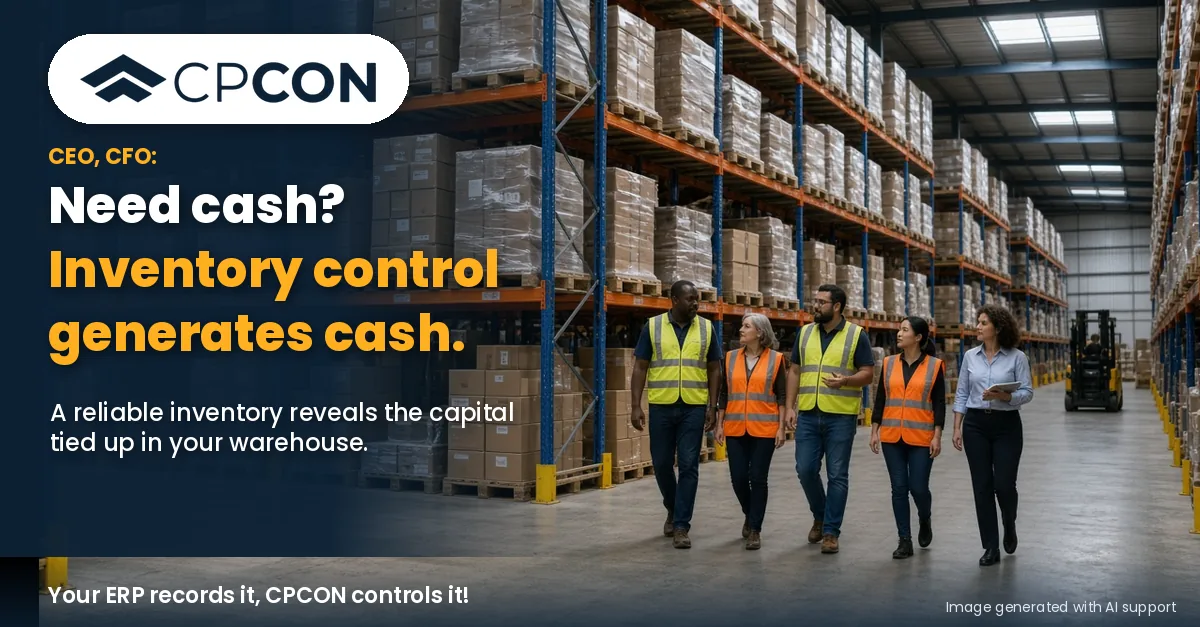
Anyone who has walked a warehouse during a stocktake knows the scene: at the end of an aisle, pallets with yellowed shrink wrap, boxes covered in dust, product codes nobody remembers buying. The goods are intact. It is just that nobody has asked for them in years. And on the balance sheet they are still worth exactly what they were on the day they arrived.
Before going further, a question for your next finance committee: what is the oldest item in your stock, and how much is it costing your business today?
The cost that is not on the label
Idle stock is never neutral. It takes up storage locations and needs insurance, handling, control and people. It loses value over time, through technical obsolescence, expiry, specification changes or simply worn packaging. And it takes up the physical and financial space that should belong to fast-moving lines.
The most damaging effect is operational: the warehouse fills up with what does not sell, while exactly what customers are asking for runs out. The business ends up with excess stock and stock-outs at the same time.
Money sitting on a shelf
When interest rates are high, this weighs even more. With money this expensive, working capital tied up in goods that do not move is a real opportunity cost: it is borrowing the business takes on, or debt it fails to pay down, while the cash sleeps in the warehouse.
That is why treating excess stock purely as a profit problem misses half the story. Selling a batch below cost creates an accounting loss, but it turns an idle asset into cash available today, which can reduce debt, fund purchases of fast-moving lines or support the investment plan. When a CFO is looking for liquidity, one of the first questions should be: what is in my warehouse, and how much of it can I turn into cash?
Why old stock stays put
In our experience with inventories and asset management, four factors explain why excess stock builds up year after year.
1. Fear of recognising the loss
Selling below cost means recognising the difference in the income statement. In a difficult year, nobody wants to make the numbers worse. In a good year, nobody wants to spoil them. So the goods stay classified as "good stock that will move in the next campaign", and at every close a little more excess joins the pile.
The problem is that postponing the decision does not remove the loss. Under IAS 2 Inventories, part of IFRS Accounting Standards, inventories are measured at the lower of cost and net realisable value, and any write-down to that value is recognised as an expense in the period in which it occurs. Carrying at full cost an item that will only sell at a steep discount is not prudence: it is a number that does not reflect reality.
2. Nobody owns the problem
In many companies, stock is treated as a matter for the stores and logistics teams rather than a financial and commercial issue. Purchasing looks at the deal, sales looks at the target, operations looks at the space. When an item stops moving, each department points at another.
Much of the excess is born at the point of purchase: targets linked to negotiated prices or volume discounts make it attractive to buy more than the market can absorb. If buyers were also measured on stock turn and on the margin actually realised, many of those batches would never exist.
3. Rigid supply chains
High minimum order quantities, long import lead times and optimistic demand forecasts push businesses towards safety stocks larger than they need. No forecasting tool is always right. What reduces the risk is flexibility: alternative suppliers, smaller initial orders for less certain items, periodic review of replenishment parameters and frequent reading of the age and turnover of each item.
4. The stocktake that only confirms the balance
This is the least discussed factor. If the annual stocktake is just a count that "validates" the ERP balance, nobody looks at the age, physical condition, location and real saleability of each item. The excess stays invisible precisely because the process that should reveal it was designed to confirm what the system already said.
What accounting and tax rules expect
Turning idle stock into cash requires technical care, and this is where many initiatives stumble.
Net realisable value. IAS 2 defines net realisable value as the estimated selling price in the ordinary course of business, less the estimated costs of completion and the estimated costs necessary to make the sale. It lists damage, total or partial obsolescence and falling selling prices among the reasons cost may not be recoverable. Estimates must be based on the most reliable evidence available and reassessed in each subsequent period; if conditions improve, the write-down is reversed, limited to the amount originally written down. A technical assessment of the recovery value of each group of items gives a sound basis for that adjustment and for the audit.
Local standards. If your business reports under local accounting standards rather than IFRS, check the equivalent requirement with your accounting team.
Tax effect. Whether a write-down is deductible, when the loss affects corporate income tax and what documentation is required all vary from country to country. Validate this with your tax team under local legislation.
Disposal and destruction. When an item has no sale value and must be destroyed, the loss needs to be documented, with destruction certificates and whatever evidence local legislation requires. Without that documentation, the business may lose the tax benefit of a loss that is already real.
Indirect taxes. Also review the treatment of VAT or other indirect taxes paid on goods that are lost, damaged or destroyed, as local legislation may require adjustments.
Each case must be validated with your tax team under local legislation. But the message is clear: leaving stock to rot in the warehouse is not a way to avoid the loss. Very often, it is the most expensive way to realise it.
How to turn idle stock into cash
There is a well-known management principle that applies to every sector: the first loss is usually the smallest. The longer an item sits idle, the less it is worth and the bigger the volume becomes, until no single channel can absorb it.
Choosing the exit channel means balancing five criteria:
- Recovery value: how much of the item's value comes back as cash.
- Speed and capacity: how much volume the channel absorbs, and how quickly.
- Commercial exposure: the risk of cannibalising full-price sales or creating conflict with the distribution network.
- Operating cost: picking, packing, transport, paperwork and commissions.
- Constraints: supplier contracts, exclusivity, regulatory and traceability requirements.
With these criteria, the most common options look like this:
- Negotiation with suppliers: returns, exchanges or buy-backs, where the contract and the relationship allow.
- Sales to your own customer base: targeted offers to existing customers on special terms, protecting the main channel.
- Secondary channels: buyers specialising in surplus stock, business-to-business platforms and auctions, with more speed and lower value per unit.
- Internal reuse: use in other plants, product lines or as spare parts, where technically feasible.
- Documented write-off: for items with no residual value, with a certificate, proper disposal and the correct tax treatment.
The approach CPCON recommends
Releasing cash from stock does not start at the auction. It starts with information. This is how we structure the work:
- A reliable inventory. Before deciding what to sell, you need to know what exists, where it is and what condition it is in. A real inventory, with cut-off, reconciliation to the ERP and treatment of variances, is the starting point. With RFID, RTLS and asset control, that visibility stops being an annual event and becomes continuous.
- Age and turnover diagnosis. We classify items by last movement, cover and criticality, separating strategic stock, recoverable excess and loss.
- Recovery value assessment. Our asset valuations estimate the realisable value of each group of items, by channel, giving a technical basis for the adjustment to net realisable value and for the sales decision.
- Disposal plan. We define the right channel for each group, with time and value targets, and with the documentation that accounting, audit and tax authorities will ask for.
- Prevention. Through stock organisation and optimisation, logistics solutions and our own management platform, we help review replenishment parameters, slotting and turnover indicators, so the excess does not build up again.
Stock as a strategic asset, once again
Excess stock is easy to ignore, and selling it means recognising a loss. But it is money the business has already paid out. Those who spot the problem early, choose the right channel, document every step and buy better from then on recover liquidity to invest where the business is growing, instead of keeping capital idle at the end of an aisle.
Your ERP records it, CPCON controls it!
Want to know how much of your stock could become cash? Talk to CPCON and start with an inventory that shows the reality of your warehouse.
This article is for information only and does not replace an accounting and tax analysis of each case. Cover image generated with AI support.
Sources
- IFRS Foundation, IAS 2 Inventories, official summary of the standard: https://www.ifrs.org/issued-standards/list-of-standards/ias-2-inventories/
- Commission Regulation (EU) 2023/1803, IAS 2 Inventories, paragraphs 6, 9, 28, 30, 33 and 34: https://eur-lex.europa.eu/legal-content/EN/TXT/?uri=CELEX:32023R1803